



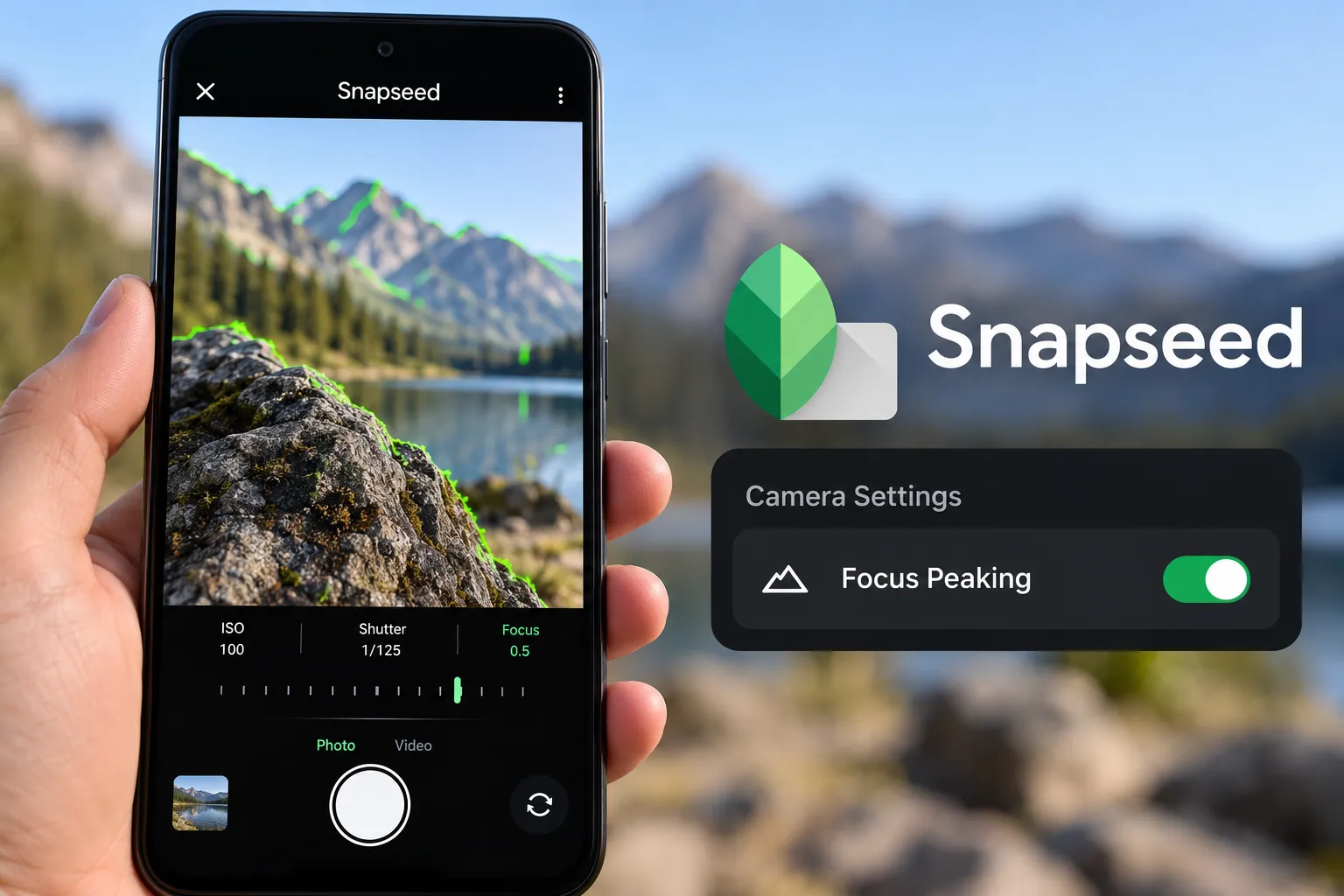
Hidden code for a "Focus Peaking" toggle has turned up inside Snapseed's Android app, but the Snapseed focus peaking feature doesn't actually work yet, even when testers force it on.
Android Authority found the code while tearing down Snapseed version 4.1.10.992428248 and only got the toggle to appear after modifying the app directly, not through any setting Google has shipped or announced.
Once enabled that way, the toggle produced no functioning focus-peaking overlay. Android Authority reports the feature simply did not work once activated, a direct admission from the outlet that ran the test, not speculation about what might go wrong.
Nothing in the report addresses iOS, and a standard Play Store install doesn't expose the setting to try. Android Authority's own test didn't produce a functioning feature, so there's no evidence that modifying the app will help anyone else get further. The outlet also cautions that features uncovered this way may never reach a public release.
That caveat matters most for anyone tracking the Google Snapseed focus peaking update specifically on Android, since that's the only platform this teardown covers. Snapseed's camera has picked up real upgrades since Google's Snapseed 4.0 redesign earlier this year, including grid lines and level controls and geotagging. Focus peaking could join that list eventually, but a hidden toggle that does nothing when forced on is a long way from a shipped feature.
What's confirmed, reported, and already shipped
Confirmed, directly from the teardown:
Code for a "Focus Peaking" toggle exists in Snapseed version 4.1.10.992428248.
The planned setting appears in Snapseed Camera settings when manually enabled.
Forcing the toggle to appear through app modification did not produce a working focus-peaking feature.
Already shipped, per the same report:
HaldCLUT support for LUT-based workflows is available in the current version.
Reported, based on Android Authority's inspection of the unfinished feature:
Focus Peaking is designed to highlight in-focus areas in the viewfinder using the app's selected theme color.
A dedicated toggle is intended to appear in Snapseed's Camera Settings.
Google appears to be developing the feature, with no public release timeline.
Unknown:
When, or whether, it reaches a stable release
iOS availability
Device and camera-hardware compatibility
Whether the final implementation will behave exactly like the unfinished version described in the teardown
What the Snapseed focus peaking feature is supposed to do
Focus peaking is a viewfinder overlay that highlights edges or details that are in focus. Android Authority describes Snapseed's version as marking in-focus areas using the app's selected theme color, with the toggle intended to live inside Camera Settings if the feature ships.
The feature is common on dedicated cameras and some advanced smartphone camera apps because it provides a visual aid when adjusting focus manually.
Importantly, Snapseed Camera already has manual focus controls on Android. The Pro mode introduced with the redesigned camera provides controls for ISO, shutter speed, and focus. That gives focus peaking an existing manual-focus control to complement rather than requiring Google to build one from scratch.
Android Authority describes focus peaking generally as useful before capturing either photos or video, but its teardown doesn't establish exactly which Snapseed capture modes will support the overlay. That remains unknown until the feature works or Google documents it.
What's already shipped in Snapseed's camera on Android
Snapseed Camera is already a substantial part of the redesigned Android app rather than an unfinished camera experiment.
Google brought the redesigned camera to Android with Snapseed 4.0 in May, including a Pro mode with manual ISO, shutter-speed, and focus controls.
Several more camera features followed:
Grid lines: Rule of Thirds, 2x2, and Golden Ratio options arrived with Snapseed 4.0.8, with None as the default.
Level: Flat-Lay, Horizon, and Tilt indicators arrived alongside the grid options and are enabled by default.
Location metadata: A geotagging toggle arrived in Camera Settings with Snapseed 4.1.1.x. It's off by default and requires location permission.
Capture original for re-editing: Also added with version 4.1.1.x, this option is enabled by default and can preserve the base image before Film Styles or Looks are applied.
Those are functioning features users can already access. Focus peaking isn't in that category yet.
RAW editing, RAW capture, and other Snapseed features
Snapseed 4.1 expanded RAW editing support on Android in July. That applies to editing RAW files, including images captured elsewhere, rather than automatically meaning Snapseed Camera itself records RAW images.
Separate teardown work has pointed to direct RAW capture as another feature Google has been developing for Snapseed Camera. Until that functionality is publicly enabled, RAW editing and RAW capture should be treated as two separate capabilities.
The same distinction matters for some of Snapseed's other recent development work.
Color Grade is no longer an in-development feature. Android Authority reported in September that the Color Grade tool had rolled out with Snapseed 4.1.6. It provides separate color-grading controls inside the editor and is available from the Tools menu.
The collage editor, however, remains unfinished. Android Authority activated an extensive collage interface in Snapseed 4.1.9 with multiple aspect ratios, layouts, layers, masks, styling controls, and template sharing, but the outlet still described it as a potential future feature rather than a public tool.
Focus peaking therefore belongs alongside features such as the unfinished collage editor and RAW capture, not the already-shipped Color Grade tool.
What Google still needs to clarify
The Snapseed-specific evidence for focus peaking comes from code inspection and an unsuccessful attempt to activate the unfinished feature. Several questions remain open:
Whether the final implementation works across all of Snapseed Camera's supported lenses and devices.
Whether it applies to every relevant capture mode.
Which Android versions or camera hardware configurations support it.
Whether Google changes the interface or behavior before release.
Whether it ships at all, since Android Authority notes that features discovered through APK teardowns can be changed or abandoned before public release.
Whether Google eventually brings the feature to Snapseed on iOS.
One question doesn't remain open: Snapseed already has manual focus. Its Pro camera mode provides a focus control alongside ISO and shutter speed, so a finished focus-peaking overlay would have an existing manual-focus workflow to support.
What Snapseed users should do now
Because the forced toggle didn't produce a working overlay, users have no confirmed workaround worth trying. Android Authority's test didn't produce functioning focus peaking, so there's no evidence that modifying the app will unlock a usable version on other devices.
Current Snapseed users can already use the camera's manual focus, ISO, and shutter-speed controls, along with grid lines, level indicators, geotagging, and capture-original saving.
Focus peaking isn't relevant to a workflow decision yet because its availability, compatibility, and final behavior remain unconfirmed.
Watch Google's Play Store changelog or Snapseed's official release information for confirmation that focus peaking has actually shipped. Until then, treat it as an unfinished Android feature found in version 4.1.10.992428248, not something ready to switch on.












Comments
Be the first, drop a comment!