



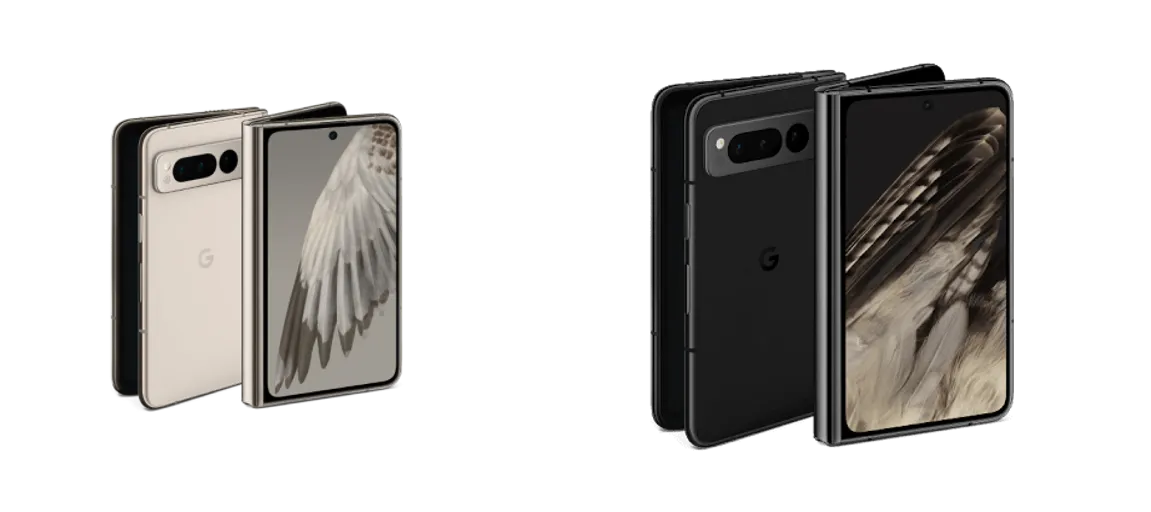
Should you buy the Google Pixel 11 Pro Fold? Early reviews from PCMag and iGeeksBlog put it head-to-head against Samsung's Galaxy Z Fold 8, and the verdict lands in a specific place: buy the Pixel for Google's software and camera approach, not because it's the stronger all-round foldable.
Google's newest fold starts at $1,899 for 256GB and climbs to $2,249 for 1TB, with 16GB of RAM at every tier. That's essentially what Samsung charges too, and reviewers who've tested both phones side by side found they solve that $1,899 question in very different ways.
Here's what's actually new about the 11 Pro Fold, where it falls short, how it stacks up against Samsung's alternative, and who should spend the money.
Google Pixel 11 Pro Fold review: what's new
Pricing breaks into three tiers: $1,899 for 256GB, $2,019 for 512GB, and $2,249 for 1TB, with the same 16GB of RAM regardless of which one you pick. That means the storage jump from base to mid-tier costs $120, and going all the way to 1TB adds $350, without touching the RAM at all. If you don't already know you need the extra storage, the 256GB model is the rational buy.
Google says the phone is almost 10% lighter and about 1mm thinner than the Pixel 10 Pro Fold, landing at about 238 grams. Whether that matters day to day depends on how you use a foldable. A few grams shaved off a candy-bar phone is barely noticeable, but foldables already sit heavier than average, and that difference compounds across a day of holding the phone open to read or type on the inner screen.
Google also touts a redesigned build: IP68 water and dust resistance, a gearless hinge, ceramic cover glass on the outer display, and a glass-fiber composite back the company says is "nearly impossible to crack." Combined, Google says the phone is three times more durable than last year's model. Those are Google's claims, not independent test results, and it's worth remembering that distinction for the rest of this review.
On the crease, the two accounts diverge. Google says it improved crease performance through a wider hinge bend radius and a thicker glass layer, but PCMag's hands-on testing found the inner display still shows a visible crease, with no active stylus support either.
Add it up and PCMag's own framing is blunt: the phone brings "scant hardware updates" dressed up with a batch of new AI features. That's a fair description of what kind of upgrade this is: iterative, not revolutionary.
Where the Pixel wins: cameras, AI, and Google's software identity
Cameras are the Pixel's strongest apparent advantage in the early coverage. PCMag's review headline calls the results "exceptional," and Google's specs back that framing up with a new 48MP main sensor and up to 30x Super Zoom. Treat this as the Pixel's best-reviewed feature rather than a proven win over Samsung, since the PCMag and iGeeksBlog coverage doesn't include a controlled Pixel-versus-Z Fold 8 camera shootout.
The software layer is where Google's identity really shows. iGeeksBlog highlights Call Screen, Scam Detection, a built-in VPN, satellite emergency access, and Gemini Intelligence woven into everyday tasks. That combination targets a specific buyer: someone already living in Google's apps who wants their phone to screen scam calls automatically and lean on computational photography rather than manual controls.
Google also commits to seven years of OS upgrades, security patches, and Pixel Drops. Samsung likewise promises seven generations of OS upgrades and seven years of security updates for the Z Fold 8. Long-term support used to separate Pixel from the pack; now it's simply what both companies offer, so it's no longer a reason to pick one over the other.
None of this changes the bigger picture. If the reason you buy a Pixel is Google's software and camera output, this phone delivers on that promise. That's a legitimate case for $1,899. It's just narrower than "this is the best foldable phone you can buy."
Google Pixel 11 Pro Fold vs Samsung Galaxy Z Fold 8
This is where the comparison turns uncomfortable for Google. Tensor G6 is designed heavily around on-device AI, with Google touting 50% more TPU compute, while PCMag's benchmarks reinforce that raw performance isn't its strongest point.
The Pixel scored 2,683 on single-core and 5,835 on multi-core, with a graphics score of 17,580 that's actually lower than the Pixel 10 Pro Fold's 18,015 from last year. Among the phones PCMag ran through its comparison set, the Pixel finished last, and in practice that gap shows up most clearly in graphics-heavy games and other demanding workloads.
Weight and charging tilt decisively toward Samsung. The Z Fold 8, priced at $1,899.99, weighs 201 grams against the Pixel's roughly 238, and it supports 45W wired charging compared with the Pixel's 30W.
There's a memory wrinkle worth flagging, too: Samsung only bundles 16GB of RAM with its top-tier $2,499.99 1TB model, while every Pixel configuration, including the $1,899 base unit, gets 16GB standard. That's one spot where the Pixel's flat memory structure actually works in its favor.
Multitasking is still a software advantage for Samsung, but the gap isn't as simple as a two-app limit. The Pixel's conventional split-screen view handles two apps side by side, while Android 17's Bubbles feature lets you open a third app in a floating window over that split-screen view. Google's support documentation specifically describes using three apps this way.
Samsung goes further with native two-way and three-way split views, pop-up windows, and DeX, so you can keep a document, browser, and chat visible in a more traditional multi-window layout. That's a real advantage on a phone whose entire pitch rests on a big inner display.
Taken together, PCMag named the Galaxy Z Fold 8 its Editors' Choice over the Pixel, citing a slimmer and lighter design, faster performance, equivalent AI capability, and stronger multitasking, all at essentially the same price. That's PCMag's judgment based on its own testing, not an industry consensus.
Is the Google Pixel 11 Pro Fold worth it? Who should buy it, and who should choose an alternative?
Before writing the Pixel off entirely, credit where it's due: battery life actually improved in PCMag's testing despite a smaller cell. The 11 Pro Fold packs a 4,806mAh battery, down from 5,015mAh in the previous model, yet it ran 14 hours and 21 minutes in PCMag's testing versus 13 hours and 42 minutes for last year's phone.
That suggests improved efficiency in PCMag's test despite the smaller battery, though the benchmark alone doesn't establish how much of the gain comes specifically from Tensor G6.
So who should actually spend $1,899 here? Buyers already invested in Google's ecosystem, who want Gemini Intelligence, Pixel's security tools, and camera output as genuine priorities, will get real value, but only if those preferences outweigh Samsung's edge in weight, speed, and multitasking.
Buyers who care more about a lighter, faster device with serious productivity chops are better served by the Z Fold 8, which is the clearest alternative to the Pixel 11 Pro Fold among the phones compared here. Current Pixel 10 Pro Fold owners have little reason to upgrade: the changes are incremental, and PCMag's graphics benchmark actually regressed year over year.
Google's launch promotion is worth weighing against that math. The Google Store is offering up to $1,000 in eligible trade-in credit plus a free 41mm Wi-Fi Pixel Watch 5, or $350 in Google Store credit, with the offer ending August 27. Treat it as a short-term discount on the sticker price, not a reason to pick this phone over a rival that beats it on hardware.
Boiled down, this Pixel 11 Pro Fold buying guide comes down to one trade-off: better-reviewed cameras and a more distinct software identity against a rival that's lighter, faster, and better at conventional multitasking for about the same money.
The Pixel 11 Pro Fold is a real improvement over the phone it replaces: lighter, more durable on paper, with a camera system PCMag describes as exceptional. But at $1,899 it's up against a rival that wins on weight, speed, charging, and multitasking in the comparisons available right now.
Buy it if Google's AI and camera approach is what you're actually paying for, not because it's the stronger all-round foldable.
Some questions remain unsettled. The "three times more durable" figure comes from Google, not independent stress testing, and long-term hinge testing is still limited this soon after release. A controlled camera shootout against the Z Fold 8 would also give buyers a firmer basis for declaring an outright camera winner.



Comments
Be the first, drop a comment!