





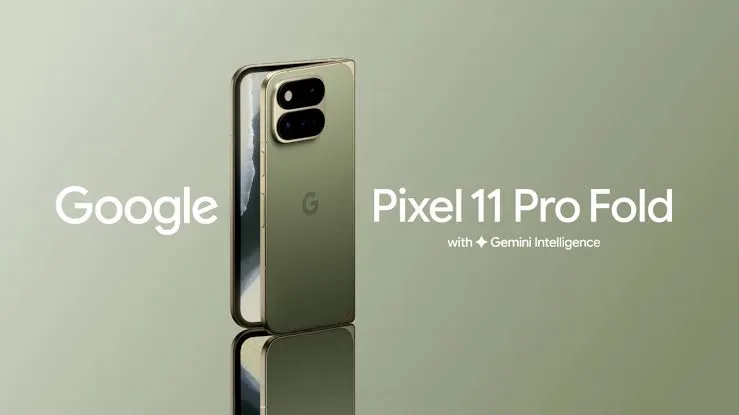
The Pixel 11 Pro Fold cracked along both antenna lines next to its hinge during a bend test, and its outer display popped clean off the frame, Trusted Reviews and Android Authority reported. The test comes from Zack Nelson, who runs the YouTube channel JerryRigEverything and put the phone through a series of scratch, flame, dust and bend tests, according to Trusted Reviews.
It's the fourth straight generation of Google's foldable to fail at the same spot. The original Pixel Fold, the Pixel 9 Pro Fold and the Pixel 10 Pro Fold all broke along that same hinge-adjacent antenna line in earlier rounds of Nelson's testing, according to Android Authority.
Google marketed this model as three times more durable than last year's Fold, built around a new gearless hinge, a ceramic-covered outer display and a hinge that Google says underwent more than 83 million opening-and-closing cycles in its reliability lab, according to Google's August 12 announcement. Despite a redesign that Google said would improve overall durability, the same hinge-adjacent area failed again.
Pixel 11 Pro Fold bend test: why did the phone crack?
The crack formed where the antenna lines create a break in the frame beside the hinge, an area Notebookcheck says needs the most structural support, not the least.
Notebookcheck's comparison is notable here: every recent Samsung foldable it has checked against Nelson's test has survived, including the 4.1mm Galaxy Z Fold 8, with the one exception being the first Galaxy Z TriFold, a limited-run concept device rather than a mainstream release. Nelson's teardown, as summarized by Notebookcheck, found that Google's hinge uses a different, non-modular design than Samsung's, which may account for some of that divergence.
Four generations breaking in the identical spot doesn't prove the antenna-line placement is the sole reason the frame gives way, and the supplied reports don't establish how many individual units were tested across those generations. The repeated location suggests a possible design vulnerability rather than a one-time manufacturing defect, though it doesn't rule out other explanations either.
Pixel 11 Pro Fold durability test results: what Nelson found beyond the crack
The front glass didn't shatter the way glass typically does under stress. It detached from the frame in a single piece, with no wires or components still attached, which Notebookcheck and Android Authority both flag as unusual for this test.
The back came off almost as easily. 9to5Google reports the rear panel could be ripped off by hand with no tools, and that Google's glass-fiber composite back scratched under a knife the way plastic does rather than glass.
The reports also differ on the outer display's scratch result. Trusted Reviews says the ceramic cover glass scratched at Mohs level 6, with deeper grooves at level 7. 9to5Google reports the outer display essentially did not scratch at level 6 and only picked up deep grooves at level 7. Both outlets agree the flexible inner display scratched around level 2, roughly fingernail hardness, a result Trusted Reviews describes as expected for a flexible display.
The flame test left permanent damage on both screens, though outlets differ on which one lasted longer. Trusted Reviews reports the outer display held up for about 20 seconds before permanent damage set in, with the inner display failing around 13 seconds. Android Authority reports the opposite, with the inner display lasting the longer stretch. Both panels ended up permanently scarred either way; the reports simply conflict on the specifics.
Fine particles reached the hinge during Nelson's test despite the phone's IP68 rating, although his test is not equivalent to the standardized IEC 60529 certification procedure. Fine particles reached the hinge area during testing despite that rating, according to Trusted Reviews. Notebookcheck says the particles could be heard collecting near the hinge, though the supplied reports don't establish whether this causes long-term damage.
Google's durability claims versus what the bend test actually measured
Google's marketing for this phone centers on the phrase "three times more durable," tied to a glass-fiber composite back described as nearly impossible to crack, a gearless hinge meant to protect the inner display, and a Super Actua outer display built with ceramic cover glass, according to Google's announcement two weeks ago. The company also rated the hinge for 83 million open-close cycles under laboratory conditions, a figure repeated by Trusted Reviews.
Google's cycle claim concerns laboratory opening-and-closing tests, while the crack occurred when Nelson bent the unfolded phone backward against its hinge, a different kind of stress entirely. The blog also points to a larger hinge bend radius and thicker glass on the inner display, changes Google says were made specifically to improve crease performance over repeated folding rather than resistance to lateral force.
Google's figures concern laboratory opening-and-closing cycles, not every kind of force the phone might encounter. Nelson's test applies concentrated force to the frame itself, and on that measure, the antenna-line area gave way at the same location reported in earlier tests.
What the Pixel 11 Pro Fold bend test does and does not prove
Trusted Reviews frames the outcome directly: the test suggests a weak point may persist outside Google's controlled lab conditions, even with the reinforcement the company advertised.
What's confirmed: Nelson has now tested one unit from each of four Pixel Fold generations, with all four failing around the same hinge-adjacent antenna-line area, despite a hinge and frame Google says were rebuilt for durability. That repetition is the clearest pattern in the available testing. The supplied reports do not include a response from Google about the antenna-line failure.
What isn't settled: whether the antenna-line placement is an unavoidable trade-off of foldable design, a Google-specific frame choice, or simply the predictable outcome of any test forceful enough to find a phone's weakest seam. Nelson's test reflects one YouTuber's methodology, not a standardized laboratory protocol.
The Pixel 11 Pro Fold reached store shelves on August 20, according to Google's announcement. Independent testing across multiple retail units could help determine whether the antenna-line failure is a consistent design limitation or a result specific to the unit Nelson bent by hand.




Comments
Be the first, drop a comment!