



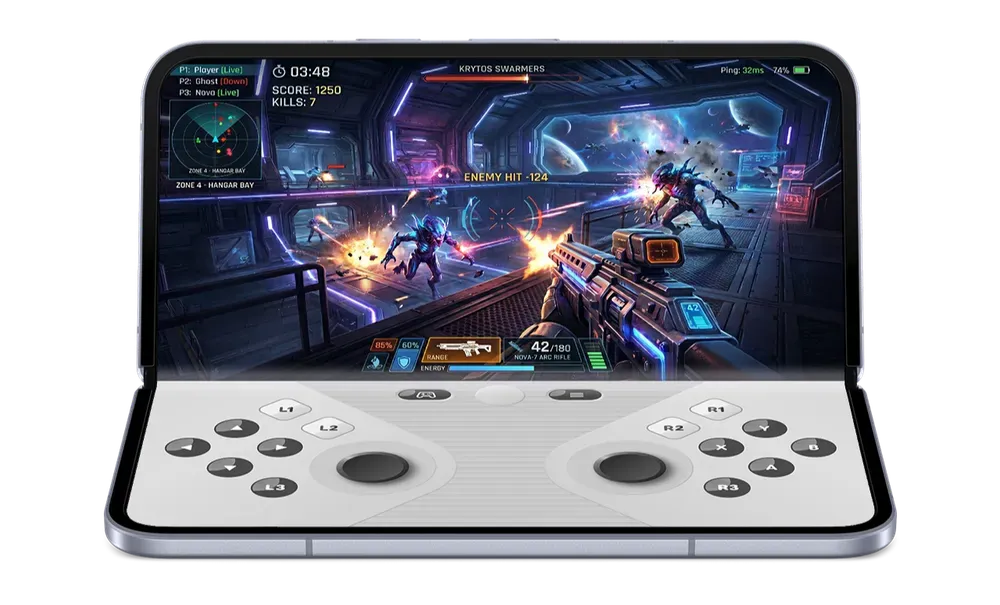
Google has confirmed a new foldable gaming mode for Android 17 that splits a foldable's inner display into gameplay on top and a virtual gamepad on the bottom. The catch: It was not included in the stable Android 17 release that began rolling out to Pixel devices on June 16, 2026.
Android 17 includes the underlying support, but the foldable gaming mode itself is scheduled to arrive in the coming months. That means there are no setup steps to follow yet, even if your Pixel already has Android 17.
More details arrived June 25, when Android Community Engagement Manager Mishaal Rahman explained how the feature works. The Verge reported that the mode is designed to emulate physical controller input at the system level, so it should work with games that already support external controllers.
Rahman framed the feature as a way to play controller-friendly games without carrying a Bluetooth or snap-on gamepad. Foldables have largely been sold around productivity and media consumption: bigger screens for multitasking, video, and reading. Gaming has been a tougher sell because the expanded inner display can be awkward for touch controls while still lacking the feel of a physical controller.
Foldable Gaming Mode is Google's attempt to close that gap using hardware that is already in people's pockets.
How Android 17 turns a foldable into a gamepad
Foldable Gaming Mode uses a 50/50 layout, with the game view on top and a software gamepad below. The setup is easy to compare to the Nintendo DS, which made the screen-above-controls format familiar in 2004. Android 17 applies a similar idea to devices that fold like a phone but open into something closer to a handheld console.
The mode is meant to start automatically once it ships. According to Rahman, activation should be as simple as unfolding a compatible device before or after launching a compatible game.
The virtual gamepad includes a broad controller-style layout: a D-pad, left and right thumbsticks, A/B/X/Y face buttons, L1/L2/L3, R1/R2/R3, and Start. Users can also customize the controls. The default stick layout is inline, but a staggered option shifts the left thumbstick, D-pad, and shoulder buttons into a more console-like arrangement.
Gamepad size scales across three options — small, medium, and large — while light and dark themes are available and haptic feedback can be toggled. That should give players some control over comfort and reach, though the feature still needs real-world testing before anyone can judge how responsive the virtual buttons feel.
The mode also knows when to stay out of the way. Touch-only games leave the gamepad hidden by default. Users can dismiss it manually through a menu, and the virtual controls turn off automatically when a physical Bluetooth or USB controller is connected.
Which games will actually work well
The feature's central technical argument is that system-level input emulation could make it work across games that already support external controllers. That is still design intent, not a tested guarantee, because the mode has not shipped.
Controller support gets you the inputs. Adaptive layout gets you the picture. Those are separate requirements. A game that supports controllers but renders at a fixed aspect ratio could still end up letterboxed or stretched in the top half of the screen.
That narrows the practically useful library. Games built for flexible displays — such as cloud gaming titles and console ports already optimized for varied screen sizes — are the most likely to work cleanly. Games designed around a fixed phone aspect ratio, even with controller support, are less certain.
Two limits stand out: Users cannot adjust the 50/50 split ratio, and the virtual controls cannot become a transparent overlay. The fixed split is the bigger constraint because some games may need more room for gameplay, while others may not need half the screen for controls.
Android 17 is also improving controller support
Foldable Gaming Mode is part of a broader set of Android 17 gaming changes.
Android 17 also introduces native system-level controller remapping, with button assignments, triggers, and thumbstick behavior saved on the device and applied across supported wired and Bluetooth controllers. That gives Android users a system-level alternative to per-game or third-party remapping tools.
Google also says Android 17 improves high-definition gameplay by reducing frame drops and stutter through more efficient memory cleanup. Neither change is foldable-specific, but together they show that Android 17's gaming updates go beyond one foldable feature.
Stable Android 17 is rolling out to supported Pixel devices, with broader Android device support expected throughout 2026. Foldable Gaming Mode is on a separate, unspecified timeline within that window.
Four questions remain: which foldables will get it, how responsive the virtual controls feel, how many controller-compatible games render well in the split layout, and whether the fixed 50/50 design feels useful across different genres.
Google has previewed a useful idea, but the feature still needs real-world testing. Until it ships, the biggest unknown is whether enough games will feel good in a fixed split-screen layout.



Comments
Be the first, drop a comment!