




RCS 4.0 Video Calls: What the Standard Defines and What's Missing
What many headlines call "RCS 4.0 video calls" refers to something more specific: GSMA Universal Profile 3.0, finalized in February 2025, which formally defines IP video call capability as part of the RCS standard for the first time. Android already has the platform infrastructure to execute those calls. What does not exist, as of March 2026, is any app that has shipped it.
The standard now has a slot for video calls. Android has the plumbing. What's missing is a shipping product.
What "RCS 4.0 video calls" actually refers to
The term "RCS 4.0" circulating online is informal shorthand. No GSMA release carries that version number. The real specification work lives in Universal Profile 3.0, finalized February 2025, and Universal Profile 3.1, published July 2025. Together, these represent the most substantive expansion of RCS capabilities since the protocol standardized under the Universal Profile framework in 2016, according to 9meters.
The video-calling additions in UP 3.0 are concrete. The spec defines capability information fields that let a device advertise IP Video Call support to other clients, and it specifies a "Video and Enriched Calling" UX with two distinct modes: one where the video-call entry point is conditionally visible and conditionally selectable, and one where it is always selectable once visible, per the GSMA specification. That level of UI prescription is how RCS specs drive consistent behavior across carriers and clients it is a blueprint, not a suggestion.
UP 3.0 also formally opens RCS as a "Messaging as a Platform" layer, allowing third-party developers to build services on top of the RCS infrastructure, the same spec notes. For context on what that means at scale: Google reported over one billion RCS messages sent daily in the US alone by mid-2025, the GSMA reported.
Universal Profile 3.1, released July 2025, added improved client-to-operator connectivity and introduced the xHE-AAC audio codec for higher-quality audio messaging, the GSMA newsroom noted. Those changes matter for calling features specifically: reliable client registration with a carrier network and audio quality worth using are practical prerequisites before video calling makes sense as a product.
What RCS video calling would actually look like in practice
Not all RCS video calling is the same, and the distinction matters for understanding what might ship first.
A fully native peer-to-peer RCS video call would mean two clients negotiating a video session directly through the RCS protocol stack, with capability exchange, session setup, and media transport all handled in-band. That is the most technically demanding option and requires both carrier network support and full client implementation on both ends.
A carrier IP video call handoff is more modest: an in-thread button that uses RCS to exchange capability information and surface a UI entry point, then routes the actual video call through the carrier's existing IP video infrastructure. The RCS layer handles the signaling; the carrier's network does the heavy lifting. This is closer to how enriched calling has worked in practice on networks that support it.
A VoIP stack shortcut is the lightest version: a button in the message thread that simply launches an existing VoIP application or service. RCS provides the UI integration point; the call itself happens entirely outside the RCS protocol.
The GSMA spec accommodates all three approaches. Which one ships first in Google Messages video calls, if any does, is an app and carrier decision, not a standards constraint. Given the gap between RCS feature definitions and real-world rollout timelines, the carrier handoff model is the most plausible near-term candidate.
Android can support this. Google Messages is the logical first mover.
Android's CallsManager API includes a specific flag indicating that a VoIP application supports video calling. Critically, the Android documentation clarifies this is a declaration of capability, not a guarantee that a call can be made at any given moment. An app can register video-calling support with the OS and activate it selectively, per call. The architecture is explicitly designed for gradual rollout.
Registering with Android's Telecom system gives apps access to shared infrastructure they would otherwise have to build from scratch: microphone arbitration with other running apps, cross-device call forwarding (a Wear OS watch can answer a call placed through a phone app, for instance), and system-level call notifications that receive top priority in the notification shade, as the Android developer documentation explains.
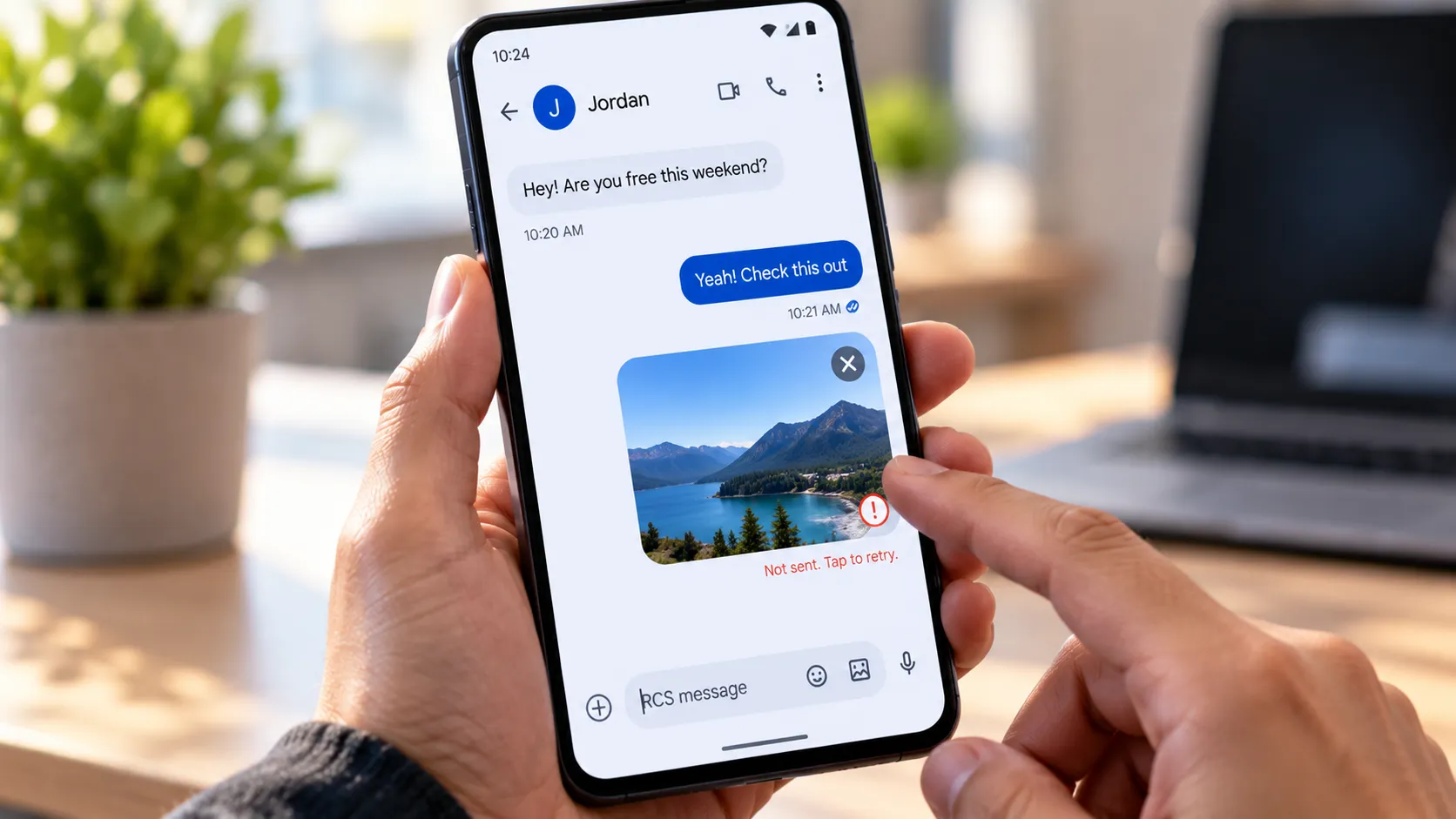
Google Messages is the most likely candidate to implement RCS video calling first. Samsung discontinued RCS support in its native messaging app in January 2025, redirecting those users to Google Messages for RCS continuity, 9meters reported. That decision consolidated Android's RCS experience in one client. Google Messages has been adding features at a steady pace through early 2026, including live location sharing powered by Find Hub, message editing with visible edit history, group @mentions that bypass muted notifications, and on-device Gemini Nano for advanced scam detection on flagship devices including the Pixel 10 series and Galaxy S26, 9to5Google tracked. Video calling would fit that trajectory. Whether Google has decided to pursue it is not publicly known.
Three things still have to line up
Carrier enablement. The RCS spec defines what carriers should support; it does not compel them to enable it. Cross-platform end-to-end encrypted RCS, a simpler capability than video calling, still had only partial carrier support as of early 2026, limited to beta and kiosk channels, Controlcenter.Cloud reported. Apple and Google are currently testing E2EE RCS across platforms in iOS 26.4 beta 2, with both apps displaying a lock icon in encrypted threads, but wider rollout is expected mid-to-late 2026 at the earliest, with geographic gaps persisting, 9to5Google and Findme.Cloud reported. Getting carriers to activate IP video call capabilities at the network level is a harder ask than enabling encrypted text.
App implementation. Google has not announced video calling for Google Messages. The feature lists tracked through early 2026 are extensive, but Google Messages video calls are not on them, per 9to5Google. Standards set a ceiling; apps decide what to build within it. The same gap played out with E2EE: the GSMA defined it in UP 3.0, and cross-platform consumer testing only began roughly a year later.
Cross-platform support. A video-calling feature in Google Messages is only useful if the person on the other end can receive the call. That requires the same capability in their client, whether another Android device, an iPhone, or a carrier app. Apple's approach to RCS has been cautious: basic messaging support arrived in iOS 18, encrypted messaging is now in beta. Whether Apple will support video-related RCS features is an open question with no public answer.
For users, the practical readiness test has four parts: the app must expose the feature, the carrier must enable it at the network level, the person being called must be on a client that also supports it, and cross-platform parity may lag by months or longer. RCS features have historically failed that checklist for years at a stretch. The GSMA's pace has accelerated, UP 3.0 in February 2025 and UP 3.1 in July 2025, but whether carriers and app developers can keep up is a separate question.
The pieces exist. The product doesn't.
The foundation for RCS video calling is real. The GSMA spec defines the capability, Android's calling stack can handle the execution, and Google Messages has demonstrated consistent feature ambition through early 2026, as tracked by 9to5Google.
Plausible and imminent are not the same thing. Consumer availability typically lags a formal spec by 12 to 18 months under favorable conditions. Carrier enablement, app implementation, and cross-platform support all have to align, and as of March 2026, none of them have publicly committed to video calling specifically.
The more useful frame is not a countdown to a feature but a platform reaching the point where such features become buildable. Video calling in messaging apps may be the next item on that list for RCS. Whether it ships in 2026 or 2027, and in what form, depends on decisions that have not yet been made in public.





Comments
Be the first, drop a comment!