



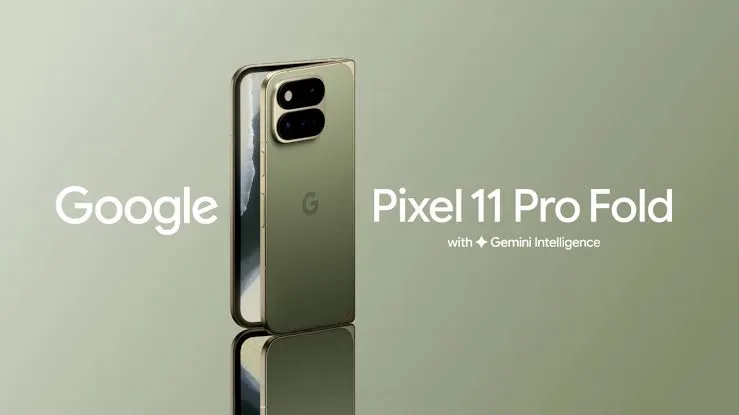
A supply-chain report claims Google is working with Samsung Display on a Pixel 12 Pro Fold crease-less display upgrade: a dual-UTG (ultra-thin glass) panel structure reportedly aimed at making the inner-screen crease far less visible than it is on the current Pixel 11 Pro Fold, according to 9to5Google, citing The Elec on September 2.
That's a supply-chain report, not confirmation from Google or Samsung Display, and it points to a tentative second-half-2027 release rather than something arriving anytime soon.
If you're shopping for a foldable right now, none of this changes what's actually on shelves. The Pixel 11 Pro Fold, which went on sale August 20, still has what The Verge called a "very obvious crease," and the same phone cracked in a bend test at the same antenna-line area that failed on the previous three Pixel Fold generations.
The rumored display change and that structural weakness address different parts of the phone. A dual-UTG screen could reduce crease visibility without changing the frame, hinge-adjacent antenna lines, or other structural components involved in the bend-test failures.
What's reportedly changing: the dual-UTG rumor
The Elec reports that Google, Oppo, and Vivo are working with Samsung Display to adopt dual-UTG panels for their next foldables. Oppo and Vivo are expected to ship their versions in the first half of 2027, with Google's next foldable expected in the second half.
An August launch would fit Google's recent Pixel schedule, but Google has not announced a Pixel 12 Pro Fold release date.
The same report links Apple's first foldable iPhone to comparable dual-UTG technology aimed at minimizing the crease. Apple is expected to unveil its first foldable at its September 9 event, but neither the phone nor its display construction has been officially confirmed.
Samsung's newest foldables have already made the crease much less visible while getting thinner and lighter. Oppo and Honor have also pushed crease visibility down substantially. If the dual-UTG report holds up, Google's upgrade would aim to close that gap rather than set a new foldable-display standard.
There's nothing to check or enable today. The feature remains tied to an unannounced phone expected in 2027.
Pixel 12 Pro Fold crease-less display: what dual-UTG means
The reported structure places one ultra-thin glass layer above the OLED panel and a second underneath it to support the display.
The report doesn't explain exactly how Google's finished implementation would reduce crease visibility, so the layer arrangement alone doesn't establish how flat the screen will look in normal use.
"Less visible crease" also doesn't mean every manufacturer is using identical hardware. Samsung uses a titanium plate beneath the OLED in its newest foldables, while Oppo has described filling the crease area using liquid 3D printing and thicker glass.
Google's reported dual-UTG design would be another approach to the same goal.
It's still unknown whether Google's version would look effectively crease-free or simply improve on the Pixel 11 Pro Fold. There are no published measurements for crease depth, display thickness, device weight, or touch feel.
Dual-UTG changes the display stack itself. It doesn't establish anything about the phone's frame, hinge construction, or antenna placement.
The durability problem a new screen won't touch
That separate problem appeared again when JerryRigEverything put the Pixel 11 Pro Fold through its extreme durability test.
The phone cracked along both antenna lines next to the hinge, the same area where the original Pixel Fold, Pixel 9 Pro Fold, and Pixel 10 Pro Fold broke during previous tests, according to Android Authority. That makes the Pixel 11 Pro Fold the fourth consecutive Google foldable to break at that location during JerryRigEverything's reverse-bend testing.
The outer display also detached from the body during the test.
Google says the Pixel 11 Pro Fold is three times more durable than the Pixel 10 Pro Fold, based on internal testing of preproduction devices. The company attributes that improvement to a new gearless hinge, stronger ceramic cover glass, and a glass-fiber composite back cover designed to resist cracking.
Google also says the new hinge improves crease performance through a larger bend radius and thicker inner-display glass. Those claims describe Google's controlled durability testing and component changes, not performance under JerryRigEverything's forced reverse-bend test.
Fine particles also entered the hinge during the durability test despite the phone's IP68 rating. IP68 certification covers defined laboratory dust- and water-resistance conditions; it doesn't mean every moving part is impermeable to particles under an extreme stress test.
JerryRigEverything's bend test isn't a measure of normal failure rates or everyday use. It deliberately pushes phones beyond ordinary handling to expose structural weak points.
What stands out is the repeatability: four generations have now broken around the same hinge-adjacent antenna-line area under that test. The precise engineering cause hasn't been established independently.
The Pixel 12 Pro Fold display report doesn't address the frame, hinge, or antenna bands, so it provides no evidence that Google has changed that part of the design.
What's still unknown about the Pixel 12 Pro Fold
Several important details remain unresolved:
Release timing: The second-half-2027 window comes from supply-chain reporting. Google hasn't announced the Pixel 12 Pro Fold or its launch date.
Crease visibility: Dual-UTG doesn't guarantee that the fold line will disappear completely.
Display dimensions and feel: Size, thickness, weight, crease depth, and touch characteristics haven't been reported.
Price: No Pixel 12 Pro Fold price information has surfaced in this report.
Structural durability: Nothing in the dual-UTG report addresses the hinge-adjacent antenna lines or the frame weakness seen in bend tests.
The rumored display construction will need confirmation from Google or hardware evidence closer to launch, while its actual visual and durability performance will require testing on finished devices.
Should you buy the Pixel 11 Pro Fold now or wait for the Pixel 12 Pro Fold?
If you want a Pixel foldable today, judge the Pixel 11 Pro Fold on what's already known. It starts at $1,899 for 256GB, $100 more than the Pixel 10 Pro Fold. Moving to 512GB costs another $120, while the 1TB version costs another $230 beyond the 512GB model.
The starting-price increase is new to the Pixel 11 Pro Fold. Both the Pixel 9 Pro Fold and Pixel 10 Pro Fold launched at $1,799.
The Pixel 11 Pro Fold also has a clearly visible inner-screen crease, despite Google's own claim of improved crease performance over the previous generation. Samsung and Oppo currently do a better job of minimizing that fold line visually.
An unconfirmed successor expected roughly a year from now doesn't automatically make the current model a bad purchase. The Pixel 11 Pro Fold's price, cameras, software, dimensions, battery, and display are all known quantities that can be compared with today's alternatives.
Buyers who care most about crease visibility may have more reason to wait. The reported dual-UTG structure could be a substantial improvement, but there's no finished Pixel 12 Pro Fold display to judge yet.
Don't treat the dual-UTG rumor as evidence that Google has also fixed the recurring bend-test weak point. The display report says nothing about frame, hinge, or antenna-band durability. That remains a separate question for the next Pixel Fold generation.


Comments
Be the first, drop a comment!