



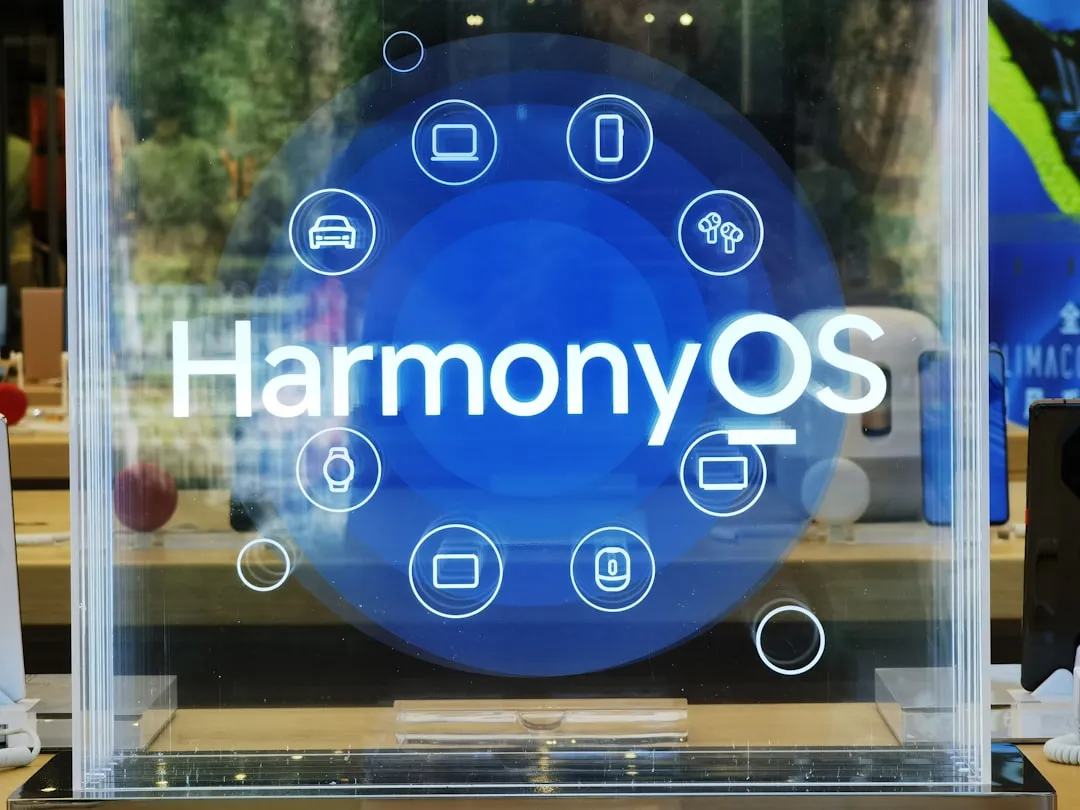
Huawei reportedly unveiled HarmonyOS 7, a major upgrade to its self-developed mobile OS that the company is framing as its entry into what it calls the "agent era" positioning the platform less as a conventional Android rival than as an AI-agent system designed to coordinate complex tasks autonomously across devices. The announcement puts HarmonyOS 7 features directly in competition with Apple's iOS 27, according to South China Morning Post.
The launch includes references to new 3D spatial interface effects, but available sourcing doesn't describe those features in enough detail to assess them, so this piece sets them aside. The substance worth examining is the AI-agent architecture, the platform break from Android that made it structurally possible, and the app ecosystem gap that will determine whether any of it matters in practice.
The HarmonyOS 7 beta release is now live for developers. Consumer availability is tied to a Huawei flagship phone expected later this year. The new OS connects to more than 2,000 specialized AI agents through a rebuilt voice assistant, and Huawei claims performance gains of 30–40% over rival operating systems. Those figures come from Huawei executives at a product launch event for software still in beta.
The platform foundation: how Huawei's break from Android made this possible
Understanding what HarmonyOS 7 is claiming requires understanding what's running underneath it. HarmonyOS Next, the architectural base the new release builds on, is not Android with a different launcher. Huawei switched to its own microkernel and stripped out all Android Open Source Project compatibility layers entirely, as Android Authority previously reported. The result is a separate operating system with no Linux foundation.
The practical consequence is blunt: every app that hasn't been explicitly rebuilt for HarmonyOS simply doesn't run. No native Android app compatibility, and no simple APK fallback. Users who update to HarmonyOS Next, or buy a device with it pre-installed, can only use apps purpose-built for the platform. That's the clearest source of risk in this launch.
The break also resolves a long-running internal problem. For years, Huawei ran Android on phones while running a different OS variant on its other hardware televisions, wearables, laptops, smart home appliances. Android Authority described that arrangement as "awkwardly bridging the gap," with the company's broader platform ambitions effectively stalled. HarmonyOS Next was designed from the start to run across all of those device categories under a single stack .
Because the OS is built to run across phones, laptops, TVs, wearables, and smart-home devices, Huawei's cross-device assistant demos rest on a unified system rather than the Android-era workarounds that previously held the company back. The voice assistant reaching across to locate a file on a connected laptop works, at least in principle, because both devices are running the same underlying OS.
HarmonyOS 7 features: what the AI-agent platform claims to do
The rebuilt voice assistant is the centerpiece of HarmonyOS 7 AI upgrades. It retains context across conversations, draws on past interactions, and routes tasks through a network of more than 2,000 specialized AI agents depending on what a given request requires, according to SCMP. The design logic is an orchestration layer, not a single assistant closer to a coordinator that hands work to specialized tools than to a general-purpose chatbot.
Huawei demonstrated two use cases at its developer conference: generating a personalized marathon training plan by pulling from health and calendar data, and remotely locating and sending a file stored on a connected laptop. Consumer Business Group chairman Richard Yu claimed the agent framework achieves a 90% success rate on complex tasks and simplifies AI development for third-party developers, per SCMP.
The OS also integrates natively with Huawei's PanGu-Σ large language model, built to scale from device-level processing up to cloud deployments, according to Android Authority. That supports Huawei's platform story: agent behavior is being presented as part of the OS stack, not merely as a standalone chatbot layer.
All of these figures, the 90% success rate, the 30–40% performance gains, the 2,000 agents, come directly from Huawei, stated at a product launch, for an OS still in beta. No independent benchmarks exist. The claims haven't been tested outside controlled conditions. That's not a reason to dismiss them, but the gap between a promising architecture and a validated product won't close until the OS ships on consumer hardware later this year.
The test that matters: apps, developers, and China's market scale
Sophisticated AI architecture is only useful if the apps people actually need are there. On that front, HarmonyOS 7 inherits the same problem that has defined the HarmonyOS Next rollout: with Android compatibility fully removed, every application must be purpose-built for the platform.
Huawei is working to port 4,000 of China's 5,000 most-used apps to the platform, according to Android Authority, which means the effort is ongoing, not finished. Developer documentation offers some encouragement: apps built on clean TypeScript practices can reportedly retain 90–97% of their codebase in a port, per Android Authority. That's the best-case migration scenario. For most development teams, removing AOSP dependency still represents a real cost, regardless of how clean the tooling is.
What gives Huawei a plausible path is market scale. The company claims roughly a quarter of China's smartphone market. That installed base is large enough to make porting commercially rational for developers targeting Chinese users. But Android still commands the largest single share of that same market, and Android Authority's assessment was that HarmonyOS becoming dominant in China would take years, and likely requires external forces pushing consumers off Android rather than Huawei's platform momentum alone.
The stakes read differently depending on who's asking. For consumers, the question is whether the apps they rely on day-to-day are actually there. For developers, it's whether Huawei's domestic install base justifies a dedicated port, particularly for apps that already run fine on Android. For anyone watching the mobile platform landscape, it's whether Huawei is building a durable third ecosystem or a technically capable product that stalls at the app layer, as other non-Android attempts have before it.
What to watch from here
The developer beta is live. Consumer launch is expected later this year alongside a new Huawei flagship. Between now and then, the signals that matter won't be Huawei's own benchmark numbers.
Watch beta developer feedback on whether the agent framework performs outside staged demos. Watch the app porting pipeline how many of those 4,000 targeted apps are confirmed and shipping by consumer launch. Watch whether any independent benchmarks emerge to test the 30–40% performance claims. And watch developer uptake: if third-party teams outside Huawei's direct partnerships start building agent integrations, that's a meaningful sign the platform is gaining traction.
If the AI layer and the app library both deliver at consumer launch, Huawei will have built something no non-Android mobile OS has pulled off: an independent platform with enough ecosystem depth to be genuinely usable. If either lags, the architecture will have arrived ahead of the ecosystem it needs, as the Android Authority analysis of this transition flagged in late 2024. The next few months will start to show which way it's going.

Comments
Be the first, drop a comment!