



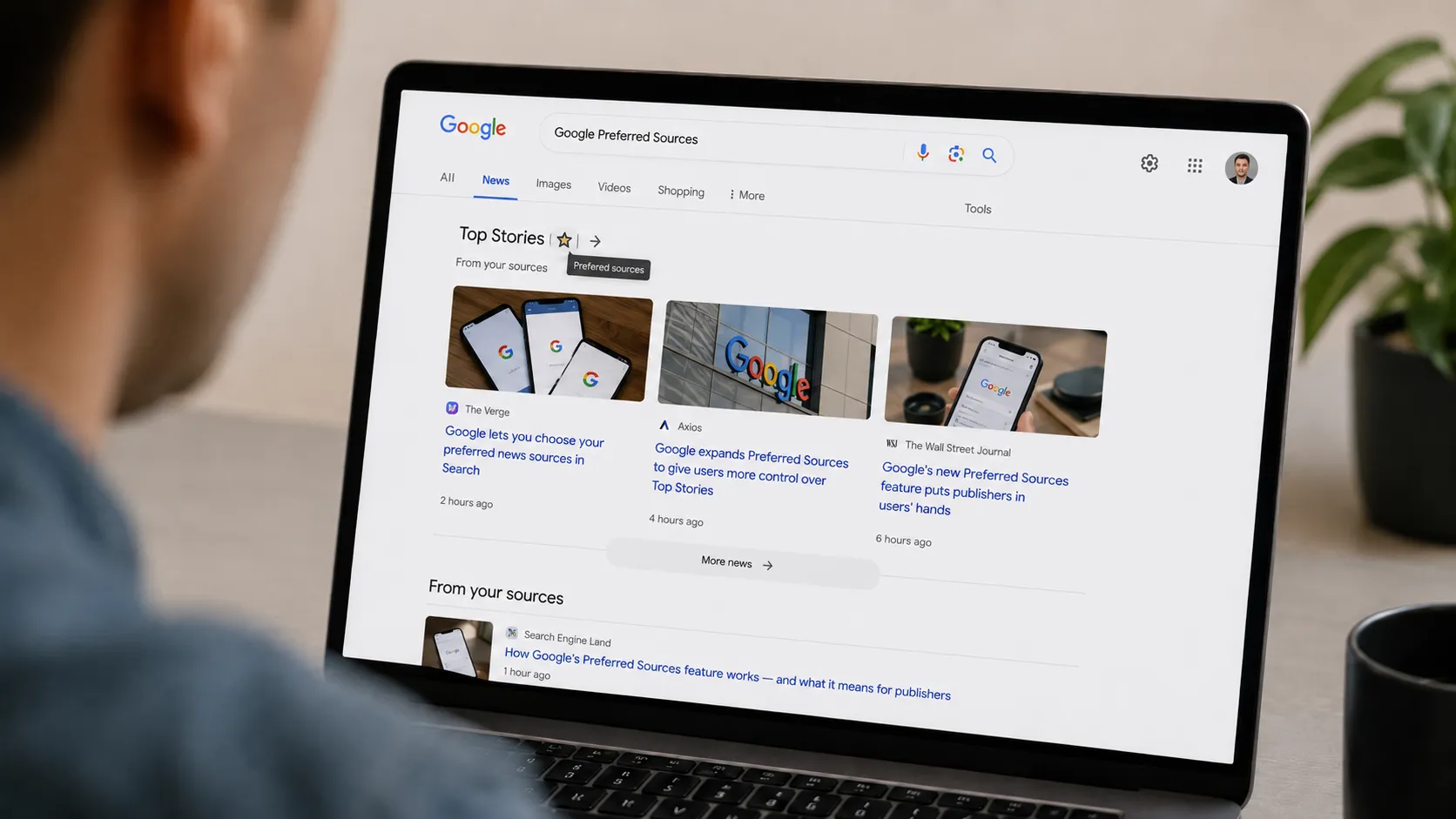
Google now lets Search users across supported languages favor specific outlets and sites in Top Stories. The feature, called Preferred Sources in Search, expanded worldwide for English-language users in December 2025. Google then expanded the feature to all Search languages it supports on April 30, 2026, per Google's announcement, per Google's announcement.
The short version of what changed: tap the star icon next to the Top Stories module, select the outlets you want to prioritize, and those sources will surface more often in your results. Non-selected outlets still appear alongside them. It's a nudge to the algorithm, not a replacement for it.
The feature had been building toward this for months. It started as a Labs experiment in June 2025, graduated to general availability in the U.S. and India in August, and reached a global English-language audience by December, according to Google's Search customization post.
Early uptake was broad. Google said in its April 30, 2026 update that users had chosen more than 200,000 sites, spanning small local publishers and major global outlets. More than half of early Labs participants selected four or more preferred sources, which suggests people treated the tool as a reading list rather than a single-outlet preference, Google reported.
Google is presenting the feature as both a reader-control tool and an argument that personalization can help route users back to publishers, at a moment when its own AI products are raising questions about how much search traffic actually reaches news sites.
How to customize Google Top Stories with Preferred Sources
Tapping the star icon next to the Top Stories module opens a source selector. Selected outlets then appear more often in the standard Top Stories carousel, or in a dedicated "From your sources" section when enough relevant content is available. Selections persist across future searches and can be adjusted at any time, per Google's August 2025 feature guide.
There is one constraint worth understanding upfront: preferred sources only surface when they have recent coverage that fits the user's query, as Google noted in the same guide. Choosing a source raises its priority when conditions are met; it does not guarantee its presence on every results page.
What the feature does not do is equally important. It does not force a preferred outlet into every Top Stories result. It does not remove other outlets from view. Google says users will still see content from other sites, with preferred sources appearing in addition to, not instead of, the broader mix. And it does not appear to be a full ranking override. A preferred source with no fresh, relevant coverage for a given query simply will not show up, regardless of the preference setting.
The practical use case is specific and real: a reader who trusts a particular local paper or specialist publication for a given topic can now surface that outlet's coverage without manually navigating to it. The feature is most useful when a preferred source has relevant content that might otherwise be buried behind higher-traffic national outlets.
Whether more control means a narrower news diet is the obvious counterargument. Google's design choice, keeping non-selected sources visible, is its answer to that concern. How prominent preferred results are relative to others is something Google has not published data on.
The rollout timeline shows a deliberate pattern
Preferred Sources didn't land in isolation. It was one component of a broader package Google announced in June 2025 to make Search more responsive to explicit user preferences. That same announcement described promoted results for frequently visited sites and automatic Top Stories updates for repeated searches, framing them as part of a broader shift in how Search handles personalization.
A similar preference pattern appeared in Discover in September 2025, when Google added follow controls for publishers and creators directly within the feed. Then in December 2025, alongside the global English-language expansion of Preferred Sources, Google announced subscription-link highlighting for users' paid news sources, with rollout planned first for Gemini and later for AI Overviews and AI Mode.
The pattern across Google's own announcements points to preference and publisher-linking infrastructure being replicated across products in sequence. Preferred Sources itself remains tied to Top Stories, but the broader strategy is visible across Search, Discover, and Google's AI Search experiences.
What Google claims it means for publishers, and what remains unproven
Google isn't only pitching Preferred Sources to readers. It has given publishers dedicated help-center resources to encourage their audiences to add them as a preferred source, framing the feature as a direct audience-building tool, per the December 2025 expansion post. Google's Search Central guidance says only domain-level and subdomain-level sites are eligible, and it gives publishers deeplinks and button assets to encourage readers to add them.
Google's main claim: users who designate a preferred source click through to that site twice as often on average, according to the same post. That figure comes from Google's own data with no disclosed methodology, sample size, or comparison baseline, and has not been independently verified. It is the strongest publisher argument in the announcement, and also the least supported.
Two other publisher-facing moves were announced in December 2025, though the evidence behind them is uneven. First, Google said subscription-link highlighting would surface links from users' paid news subscriptions in a dedicated carousel, with priority placement extending to the Gemini app, AI Overviews, and AI Mode. Google has since said early testing found that people were significantly more likely to click links labeled as subscriptions, but it has not disclosed the methodology, sample size, or baseline behind that claim. Second, Google announced a commercial AI partnership pilot with publishers including Der Spiegel, El País, Folha de S. Paulo, Infobae, Kompas, The Guardian, The Times of India, The Washington Examiner, and The Washington Post, among others. Google says it is testing AI-powered article overviews and audio briefings on participating publishers' Google News pages, with attribution and article links included. No public performance benchmarks from that pilot have been published.
The unresolved tension sits in that pairing. AI Overviews and audio briefings can surface information without requiring a click. Preferred Sources and subscription highlighting are designed to route users toward publishers. Google's publisher pilots are its argument that the two approaches can coexist. Google has not published traffic or engagement data that tests whether that argument holds.
What comes next
Preferred Sources is now a functioning global feature across supported Google Search languages. The open questions are adoption, publisher impact, and how often selected sources appear relative to other Top Stories results. Subscription-link highlighting has since moved into rollout in AI Mode and AI Overviews, while the publisher AI pilots remain harder to evaluate because Google has not published detailed performance benchmarks.
The open questions aren't really about the feature itself anymore. They're about whether enough users discover and use it to matter, whether Google will publish independent metrics on its effect on publisher traffic, and whether the preference logic now running across Search, Discover, and Gemini-related products adds up to something durable or just a well-coordinated product announcement cycle. Google still has not published independent traffic metrics or detailed methodology for its publisher-impact claims.







Comments
Be the first, drop a comment!