





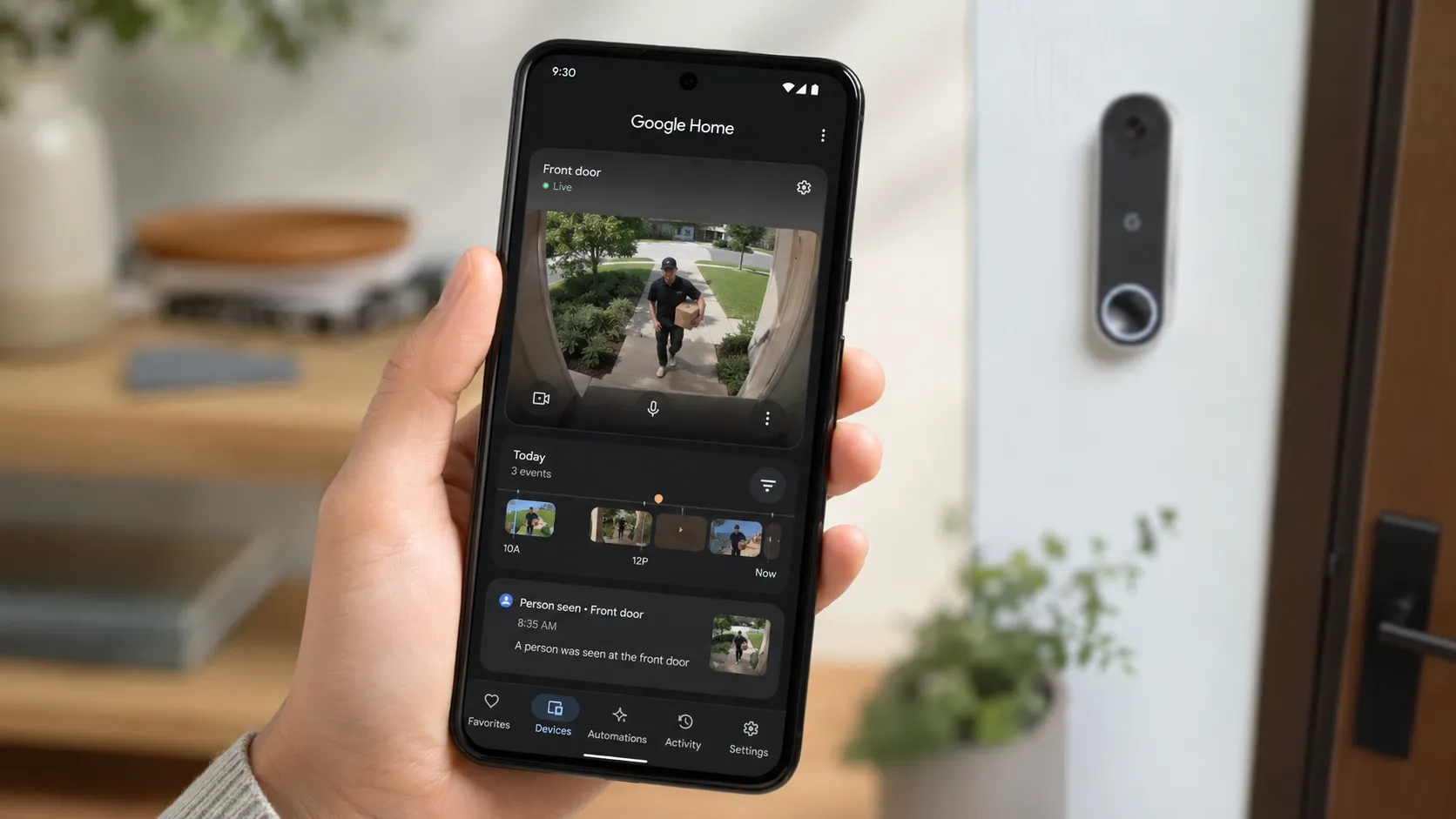
Google's late-April 2026 Google Home app update brings a modernized camera interface, consolidated notification controls, redesigned casting controls more broadly, and speed improvements to Gemini voice commands, 9to5Google reported. The changes are unglamorous but cumulative — another round of friction removal from a platform that has been getting meaningfully less annoying to use since October 2025.
At that October 2025 relaunch, Google said the app loaded over 70% faster on some Android devices, app crashes had fallen nearly 80%, live camera views loaded 30% faster, and playback failures dropped 40%. This new update builds on that foundation rather than replacing it.
Much of the interface and media-control work ships broadly, while the most advanced Gemini camera features remain tied to Google Home Premium eligibility. The layer that costs money — AI-generated camera history descriptions, natural-language video search through Ask Home, and Home Brief — remains real and improving, but those camera AI features require Google Home Premium Advanced, which costs $20 per month or $200 per year. Google Home Premium Standard starts at $10 per month, while Google says Premium is included at no extra cost with Google AI Pro and Ultra subscriptions, though the included tier depends on the plan. Gemini for Home's voice-assistant component remains in early access, according to Google's release notes.
Google followed that with another Google Home update on May 11, 2026, adding more Gemini for Home voice-assistant improvements, including faster everyday smart-home actions and expanded Ask Home-style voice capabilities.
Google Home updated camera experience: what changed
An "Updated Camera Experience" is beginning to roll out, 9to5Google noted in its April 28, 2026 report. The redesign adds dynamic theming and makes key features more accessible, particularly at the bottom of the screen. Camera settings are now easier to find, and features including Gemini for Home, familiar face detection, and Activity Zones have been elevated in the interface rather than buried in nested menus.
Activity Zones — the feature that lets users define specific motion-sensitive areas within a camera's field of view — are now faster to configure and update, 9to5Google reported. That speed claim comes from Google; independent benchmarks aren't yet available.
Seen and heard events, previously split across separate pages, are now combined into a single screen for event recording and notification configuration. If tracking down the right notification toggles has ever sent you through three menus, that's the fix. The consolidated event-recording and notification controls are part of the broader camera UI update and do not appear to require a Premium subscription, though availability can still depend on rollout timing, device support, and app version.
Google Home media controls update: casting for all users
The new media control experience for casting through the Google Home app is now rolling out broadly, covering Google smart speakers, smart displays, the Google TV Streamer, and other Cast-compatible devices, 9to5Google reported. The redesigned layout puts album artwork front and center and improves access to playback controls and device management.
Two reliability fixes sit alongside the redesign. Controller pages now surface an instant account-relinking prompt when an expired partner integration is what's actually causing a device to appear offline — the kind of hidden connection error that used to produce a cryptic "device not responding" message with no obvious next step, per 9to5Google. Feedback reports submitted through the app now include more detailed diagnostic information to help Google fix reported issues faster.
None of this is headline material. All of it reduces the odds that someone blames their Nest speaker when the real problem is an expired OAuth token, and these media-control and reliability changes do not require a Premium subscription.
Gemini voice commands are getting faster and less interruptive
For users enrolled in Gemini for Home early access, the update delivers speed improvements to the most commonly used commands. By optimizing how it processes device commands and home layouts, Google says users may notice a speed boost of up to 1.5 seconds when controlling lights or plugs, 9to5Google reported. That figure is Google's stated ceiling, not a guaranteed baseline — actual results will vary by device, network, and home setup.
Alarm, timer, and reminder commands now have more efficient processing, including named timers. A command like "cancel my pizza timer" resolves without Gemini asking which timer you mean, according to 9to5Google. These speed improvements are live for English, French, and Spanish users in supported countries, with more languages coming.
The subtler improvement is in conversational handling. Gemini is now better at identifying whether a request is a standalone command or a follow-up in an ongoing exchange, which cuts down on unnecessary clarifying questions. It can also determine when to ignore irrelevant background speech — particularly useful for users with Continued Conversation enabled, where the assistant stays listening after an initial interaction. Custom Routines have been refined to run without interference from simultaneous commands, per 9to5Google.
A 1.5-second improvement on a light switch command sounds incremental. In practice, it's the difference between a voice control that feels responsive and one that seems to be thinking about it.
Google Home camera AI descriptions and searchable video history
The features with the most functional upside sit behind the higher paid tier: AI-generated descriptions in camera timelines, natural-language video search through Ask Home, and the Home Brief daily summary require Google Home Premium Advanced, which costs $20 per month or $200 per year. Google Home Premium Standard starts at $10 per month, and Google Home Premium is included at no extra cost with Google AI Pro and Ultra subscriptions, though the included tier depends on the plan, according to Google's Gemini for Home launch materials.
For Advanced plan subscribers, camera history timelines now include AI descriptions of recorded events, making it easier to scroll through footage and identify moments worth reviewing. Google says these descriptions have been refined to remove unnecessary clutter and improve readability at a glance, 9to5Google reported. Camera search results through Ask Home also load noticeably faster, though Google offers no quantified benchmark "noticeably" is the company's own word.
The natural-language search capability is where the paid tier makes its clearest case. Google cites questions like "What time did the kids get home?" and "Did I leave the car door open?" as examples of what Ask Home can retrieve from hours of recorded footage, per the Gemini for Home launch post. That's a substantively different product from rewinding a timeline by hand.
One practical addition for Google Home Premium subscribers: subscriptions will now be temporarily paused rather than canceled outright during a payment issue, meaning video history and related saved features should not be lost immediately during a billing gap, 9to5Google reported.
All performance and accuracy claims for the AI descriptions come from Google. Independent testing of description accuracy, edge-case handling, and privacy implications for AI analysis of home footage remains limited. Treat these as vendor claims until they're not.
What's still rolling out and what remains early access
This update is not a full platform relaunch. It's the same reliability-and-usability work that has characterized Google Home development since the October 2025 relaunch, applied to camera settings, casting controls, and voice command handling. The camera UI changes and consolidated notification controls are worth checking for in your app version — no subscription required, no early-access enrollment needed.
Google Home Premium is not buying a better camera. At the Advanced tier, it buys a different relationship with recorded footage: searchable, summarized, readable history rather than raw video you scroll through manually. Whether the AI descriptions are accurate and consistent enough to depend on in daily use remains an open question that Google's own materials cannot answer.
Gemini for Home remains labeled early access in Google's May 11, 2026 release notes. The Updated Camera Experience is still in rollout. The gap between what Google describes and what independent testing eventually confirms is, for now, the main thing still worth watching.



Comments
Be the first, drop a comment!