



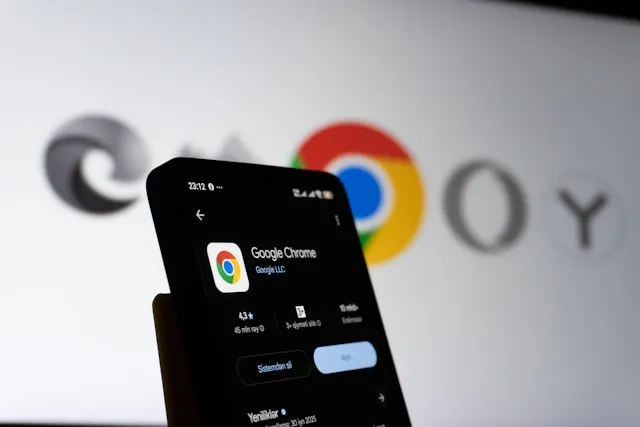
Google is testing a Chrome behavior that would send every non-URL address-bar search query straight into AI Mode, bypassing standard Search entirely. The Google Search AI Mode Chrome test surfaced in the Canary build earlier this month, and while Google moved quickly to call it an accident, its existence lands at an awkward moment: a federal court has spent the last year dismantling the exact kind of default-setting arrangements that would make such a feature legally sensitive.
The flag is narrow. Users have to manually enable it by navigating to chrome://flags in Chrome Canary on desktop, and it is not active for anyone by default. But the user base responding to Google's broader AI search push was already moving before the flag appeared.
How the Chrome omnibox AI Mode flag works
The flag's own description leaves little ambiguity. Google's internal label for it reads: "Redirects all normal searchbox queries in the omnibox and realbox to AI mode threads," covering Mac, Windows, Linux, and ChromeOS, according to 9to5Google. In practice, anything typed in the address bar that isn't a URL goes to AI Mode instead of a standard results page.
The omnibox is how most Chrome users access the web. Changing its destination isn't a search feature tweak; it redefines what a query means inside the browser. That's the practical weight behind an experiment most users will never encounter.
Google's public response came in two parts. A project commit stated the flag was "just for exploration" with no current plans to ship it, and VP Rajan Patel told 9to5Google: "This was an error. We're not planning to make AI Mode the default for Chrome searches." What the "error" refers to is unclear; the flag was never enabled by default for Canary users, so what exactly was mistaken goes unexplained.
The user reaction that preceded the Chrome flag
Before the flag surfaced, DuckDuckGo was already seeing unusual install numbers tied to Google's AI search push around I/O 2026. U.S. app installs rose an average of 18.1% week-over-week from May 20 to May 25, peaking at 30.5% on May 25, with iOS growth averaging 33% and briefly reaching 69.9%, per TechCrunch. The growth held through Memorial Day weekend, a period when DuckDuckGo typically sees a traffic dip.
Third-party data corroborates the trend. App analytics firm Apptopia tracked a 29% increase in average daily U.S. downloads and a 12% global increase over the same window, per TechCrunch. The timing suggests users were reacting to Google's broader AI search push, not to any single product change.
The privacy argument is part of what makes DuckDuckGo the destination rather than just a beneficiary of the moment. CEO Gabriel Weinberg stated: "Everything you do in DuckDuckGo is private, we don't collect search histories or chats and nothing is used for AI training," according to TechCrunch. For users whose concern extends beyond AI-generated answers cluttering results to what happens to their queries inside an AI-native search pipeline, that distinction matters.
DuckDuckGo turns the signal into a product
DuckDuckGo didn't just watch the install numbers; it built something around them. After traffic to its No AI search page tripled following Google's AI push around I/O 2026, the company launched browser extensions for Chrome and Firefox that make its AI-free search page the persistent default in the address bar, TechRepublic reported earlier this month. The extensions convert what had been a manual workaround into a single install.
The No AI page itself disables Search Assist, Duck.ai, and AI-generated image results. Visits to the page averaged 22.7% week-over-week growth in late May, peaking at 27.7% on May 24, per TechCrunch. DuckDuckGo promoted the extensions after those traffic numbers appeared, building a product around demand that had already shown up in the data.
An extension that sets AI-free search as the address-bar default in Chrome is a direct play on the same distribution lever Google has relied on for years. The difference is that DuckDuckGo is offering it as a choice rather than a condition.
Why defaults are now a regulated battleground
None of this plays out in a legal vacuum. A federal court found in August 2024 that Google "is a monopolist, and it has acted as one to maintain its monopoly" in violation of the Sherman Act, a ruling covering approximately 90% of U.S. search queries, according to the DOJ. The court's September 2025 remedies ruling targeted exclusive distribution arrangements, and a later December 2025 judgment limited default search and AI app placement contracts to one year.
The court prohibited Google from entering or maintaining exclusive contracts relating to the distribution of Google Search, Chrome, Google Assistant, and the Gemini app, per the DOJ. Specifically, Google cannot condition revenue-share payments on the placement of one Google application alongside another, or on maintaining Search, Chrome, Google Assistant, or Gemini as the default on any device, browser, or search access point for more than one year. The remedies explicitly extend to generative AI products, aimed at preventing Google from using the same distribution tactics to entrench its AI offerings that it used to dominate traditional search.
That's the direct line between a Chrome Canary flag and antitrust law. A feature built to redirect all omnibox queries into an AI interface sits precisely in the category of default-setting behavior the court placed under scrutiny. Google's commit called it exploration; Google's VP called it an error. If the feature moves closer to production, regulators now have standing to ask which characterization is accurate.
What the numbers actually tell us
The install surge is real and independently verified, but scale matters. DuckDuckGo holds roughly 2% of the U.S. search market, as TechCrunch noted. A company that small can post 30% weekly growth without registering in Google's aggregate query volume. What the numbers demonstrate is that a meaningful slice of users will actively change defaults when AI search feels imposed. They do not show Google losing search.
What they do establish is that opting out of AI search has become a deliberate product category. DuckDuckGo has packaged that preference into browser-level defaults designed to persist well past the current news cycle. That's a long-term bet on a user preference that may deepen as AI results become harder to disable in mainstream search products.
The Chrome Canary AI Mode search redirect is not affecting anyone who hasn't gone looking for it. For most users, nothing has changed yet. But the choices about how AI search gets delivered, and whether users can easily route around it, are becoming more explicit on all sides.




Comments
Be the first, drop a comment!