





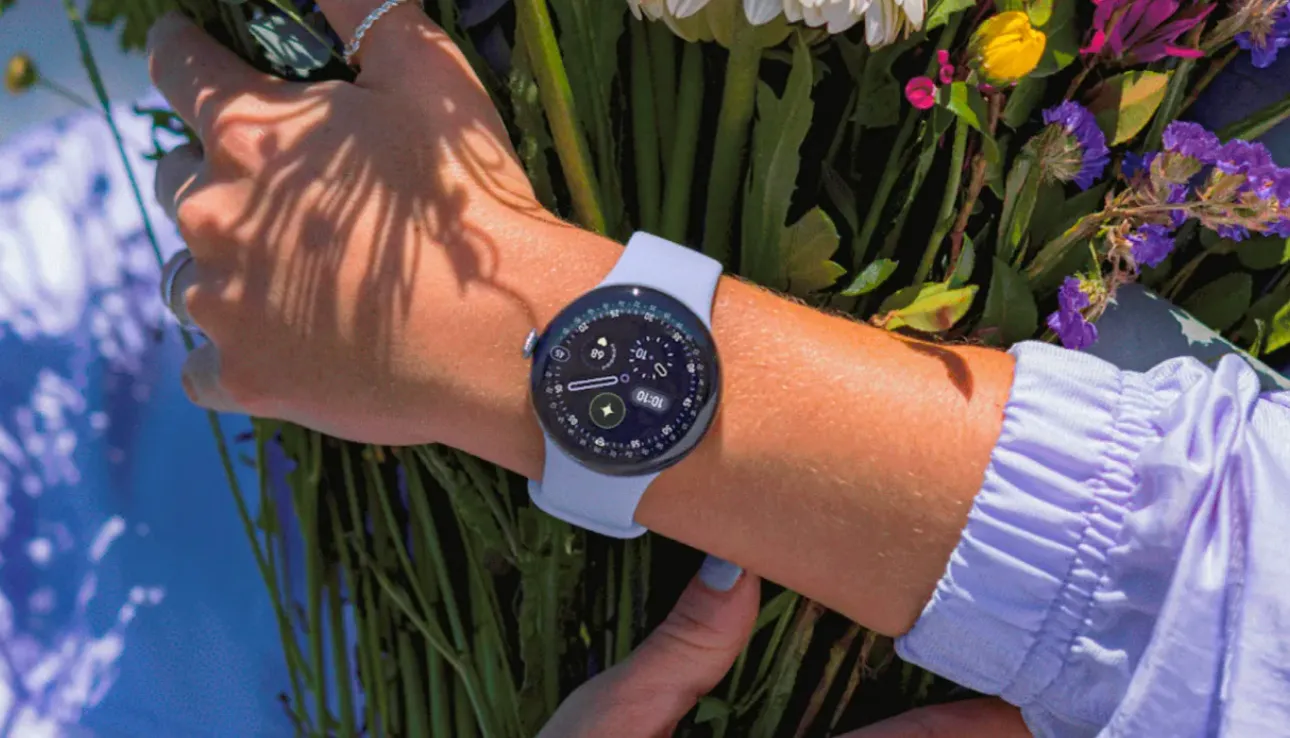
The Pixel Watch 5 has appeared in a Google Play Console listing under the codename "godric," adding to the evidence that Google's next smartwatch is nearing launch. The entry follows June regulatory filings for four probable Pixel Watch 5 models and reveals 3GB of RAM, up from 2GB in recent generations.
Those filings have also raised a bigger question: Will every Pixel Watch 5 include LTE? Droid Life interpreted the records as showing cellular and satellite-related connectivity across all four models. A separate retail leak, however, describes distinct Wi-Fi and LTE versions in both expected sizes. Google has not confirmed the final lineup.
Why the LTE evidence conflicts
The four model numbers identified in the filings are G25QD, G1XJ6, G0F3Y, and GFW3R. According to Droid Life's analysis of the FCC records, all four appear to support LTE, Wi-Fi, Bluetooth, NFC, and ultra-wideband connectivity.
The publication also identified NTN Band 23 and Band 255 support across the four filings. Those bands can be used for non-terrestrial satellite connections, but their inclusion does not prove that Satellite SOS will be enabled on every model or in every country.
Google currently makes Satellite SOS available only on the Pixel Watch 4 LTE and restricts it to supported markets. Compatible radio bands in a regulatory filing therefore do not guarantee access to the feature.
Leaked retail information points in another direction. A July 8 report lists 41mm and 45mm Pixel Watch 5 models, each available with either Wi-Fi or LTE.
According to Android Authority's report on the leaked lineup, the four expected configurations are:
41mm Wi-Fi: $399
45mm Wi-Fi: $429
41mm LTE: $499
45mm LTE: $529
The configurations and prices remain unconfirmed. Still, the leak suggests Google may retain the familiar split between less expensive Wi-Fi watches and cellular models rather than making LTE standard across the retail lineup.
One possible explanation is that the regulatory filings describe LTE-capable hardware that Google could disable or separate through software and retail configurations. Another is that the filings have been interpreted incorrectly. Google's announcement will be needed to resolve the discrepancy.
The Play Console reveals more RAM
The Play Console listing does not establish the watch's cellular options, but it provides several hardware clues. It shows 3GB of RAM, which would be the Pixel Watch line's first increase from 2GB.
More memory could give Wear OS additional room for multitasking and future software features, although the listing does not identify any specific new capability.
The entry also names Qualcomm's SW5100 platform and shows the same apparent CPU and GPU configuration used by recent Pixel Watches. It does not identify the co-processor, leaving open the possibility that Google has upgraded another part of the watch's computing system.
For buyers, the final Wi-Fi and LTE split will have more immediate consequences than the processor platform. An LTE Pixel Watch can handle calls, messages, and supported apps without its paired phone nearby, but cellular service must be activated through a compatible carrier.
Google says an LTE Pixel Watch requires a separate cellular line, even though it shares the paired phone's number. The presence of LTE hardware would not provide mobile service automatically or eliminate possible carrier fees.
Connectivity also affects emergency calls. A Wi-Fi Pixel Watch normally needs its paired phone nearby and connected through Bluetooth to contact emergency services. An LTE model can place the call without the phone, but it needs an active LTE connection or another supported safety service. Google outlines those emergency-calling requirements in its Pixel Watch documentation.
Google's August 12 event could clarify the lineup
Google has scheduled its Made by Google hardware event for August 12, 2026. The company has teased its next generation of Pixel devices, although it has not publicly confirmed the Pixel Watch 5's specifications, prices, or retail configurations.
The Play Console listing strengthens the evidence that the Pixel Watch 5 is close to launch, but it does not settle the LTE question. The FCC analysis points to four LTE-capable devices, while the leaked retail lineup still includes separate Wi-Fi and LTE options.
Google's announcement could clarify whether the company is retaining that split, how much each version will cost, and whether Satellite SOS will expand beyond the LTE tier.








Comments
Be the first, drop a comment!