





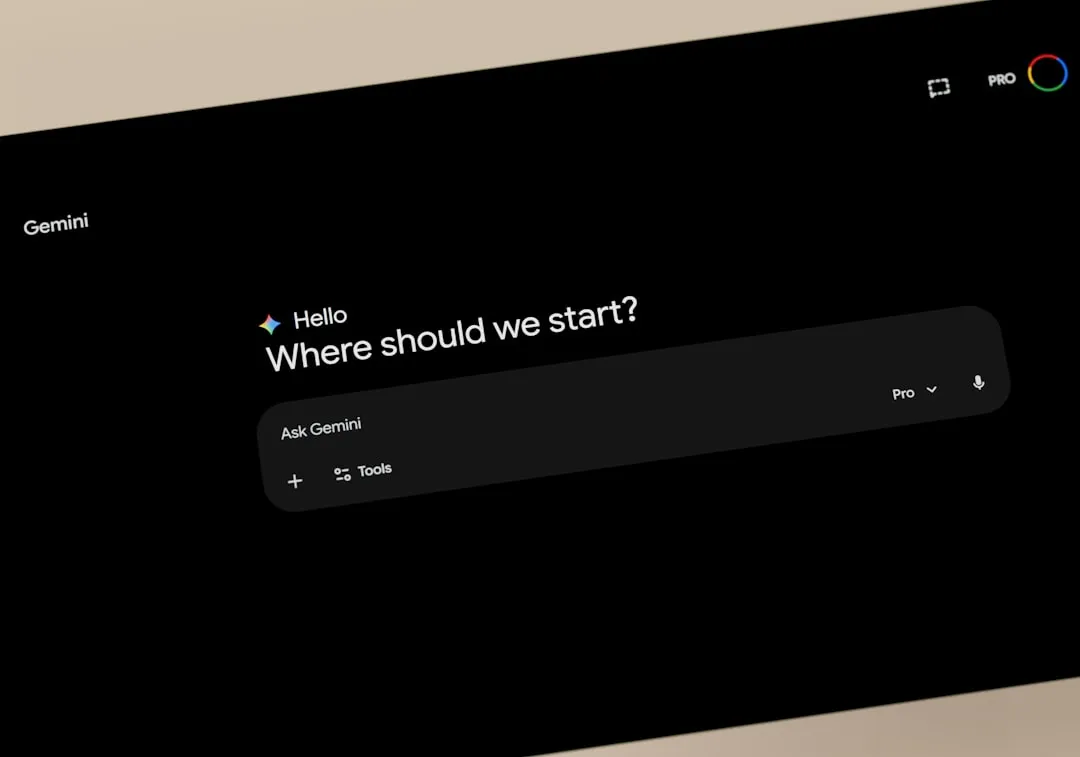
Google is marketing Gemini as "a next step toward a true generalist agent" — a tool that orchestrates complex tasks across Gmail, Calendar, and connected apps on your behalf. Months after that pitch, the Gemini multiple Google accounts problem remains unsolved. Gemini works within a single active account. That's it. Your work life and personal life stay invisible to each other, and Gemini acts as though the other half of your day simply doesn't exist.
That's not a rough edge on an otherwise finished product. It's a structural problem with the core promise.
An assistant that only knows part of your life can't be trusted to answer for all of it. And an assistant you can't trust is one you'll eventually stop asking.
What breaks in daily use
The gap shows up fast. Gemini's Daily Brief, one of its flagship personalization features, draws only from the active account. If your work calendar and personal calendar live in different accounts, you get a briefing on half your day. The other half doesn't exist to Gemini.
Gemini Agent, which Google describes as breaking down complex requests using Gmail, Calendar, and connected Workspace apps, runs into the same wall. Ask it to manage your week, and it has no visibility into commitments logged under your other account. The agent is capable. It's just working from an incomplete file.
The everyday scenarios are more telling than any feature demo. If a work colleague emails your personal address by mistake and you later ask Gemini to surface that message, Gemini won't find it — it's searching the wrong inbox. If you're tracking two deliveries, one from a work order and one personal purchase, you can't see both in the same place, per Android Authority. Anyone managing more than one Google account will recognize both of those situations immediately.
The trust problem follows directly. When Gemini's answer might reflect your full context or might not, depending on which account happens to be active, you have to second-guess everything it tells you. That's not a minor inconvenience. It's the thing that makes people stop using assistants.
Why the Gemini account switching issue makes personalization unreliable
The frustration runs deeper once you remember what Google Assistant used to do. For years, users could link multiple Google addresses to a single Assistant instance, and it would read calendars and access contacts across all of them without requiring a manual switch, according to Android Authority. Assistant was less capable in almost every other respect. On this specific dimension, it was better.
Gemini's only current workaround is a partial one: you can share calendars across accounts through a legacy Assistant pathway, which at least gives Gemini some cross-account scheduling context. But it requires manually cross-sharing each calendar, and there's no equivalent path for Gmail, Drive, Photos, or any other Google service now receiving Gemini integration, as Android Authority documents. One service out of many. Everything else stays siloed.
Gemini has already expanded to Wear OS smartwatches, Android Auto, and Nest and Google Home devices. So the one-account limitation now applies across a user's entire device ecosystem, not just their phone. Every new surface Google adds extends the scope of the problem.
This is the most damaging part of the case against Google's current approach. Multi-account awareness isn't a technically novel challenge. Google built it once, in a less sophisticated product. The question isn't whether it's possible. The question is whether it's a priority.
Account switching has gotten harder, not easier
While the underlying limitation persists, the workaround has become more cumbersome. Google recently updated the Gemini mobile app to hide the account switcher inside a side menu, removing the account avatar that was previously visible on the main screen, as Android Authority documents. For anyone who switches accounts regularly, that's a step in the wrong direction.
The Wear OS behavior is worse. Switching accounts in the Gemini phone app fully resets the Gemini instance on a paired watch back to the "Get started" screen, all previously granted permissions forgotten, requiring complete reconfiguration. This happens even when the switch is momentary: flip to a work account for a single query, flip back to personal, and the watch resets anyway.
The legitimate counterargument here is worth taking seriously. Enterprise IT policies and admin-controlled Workspace accounts create real compliance reasons to keep account data separated. Privacy regulation and organizational security aren't trivial concerns, and Google may face constraints on merging account contexts that would satisfy every compliance requirement. That's a genuine constraint.
But it doesn't explain burying the account switcher, and it doesn't explain the watch reset behavior. Strong data separation and a usable account switcher are not mutually exclusive design goals. The compliance argument applies to what data Gemini can see across accounts; it doesn't require making the switching workflow itself punitive.
Who this affects and what a fix would actually require
The affected users aren't a niche segment. Anyone running a work and personal Google account, anyone using a shared family account for household planning, anyone with a school account, anyone running Gemini across phone, watch, and home devices — all of them hit this ceiling. That likely covers a significant share of the Android user base, and it's safe to infer that high-engagement multi-account users are exactly the people Google wants subscribing to Gemini's paid tiers.
The product-level fragmentation runs wider than just the account issue. As one observer put it six months ago, "Gemini as a model is incredible. Gemini as a product is fractured". The same underlying AI scattered across overlapping entry points that behave inconsistently. The Google Gemini work and personal accounts gap is the most concrete consumer-facing version of that fragmentation. It's where the abstract product confusion becomes a specific daily failure.
A real fix doesn't require merging accounts or abandoning data separation. It requires treating multi-account usage as a first-class design case. Practical paths exist: opt-in cross-account awareness that lets users designate which accounts Gemini can query together; account switching that preserves connected device state rather than wiping it; a unified personal context layer that respects storage-level separation while presenting a coherent view at the assistant layer. None of these is an exotic engineering problem. They're product decisions.
The migration window is closing
Google pushed its full Assistant-to-Gemini migration on Android into 2026, citing the need for a "seamless transition," per The Verge, which reported this about five months ago. Once that migration completes, Assistant is gone. Users on compatible devices won't be able to access it, and the app won't be available to download.
That timeline matters because it sets a deadline. Right now, the Gemini one-account-at-a-time limitation is a gap. After the migration closes, it becomes the baseline, the permanent capability ceiling for every user who didn't notice what was missing before the switch happened.
Every feature Google announces under the Gemini umbrella arrives with reduced practical value for any user whose life spans more than one account. Daily Brief covers half a day. Gemini Agent manages half a week. The product and the marketing are making different promises.
The standard isn't perfection. It's in parity with what Google already built. Assistant reportedly handled calendars and contacts across linked accounts. Gemini 3, for all its genuine capability, doesn't. The question for the rest of 2026 is whether that regression gets corrected before the door closes.



Comments
Be the first, drop a comment!