



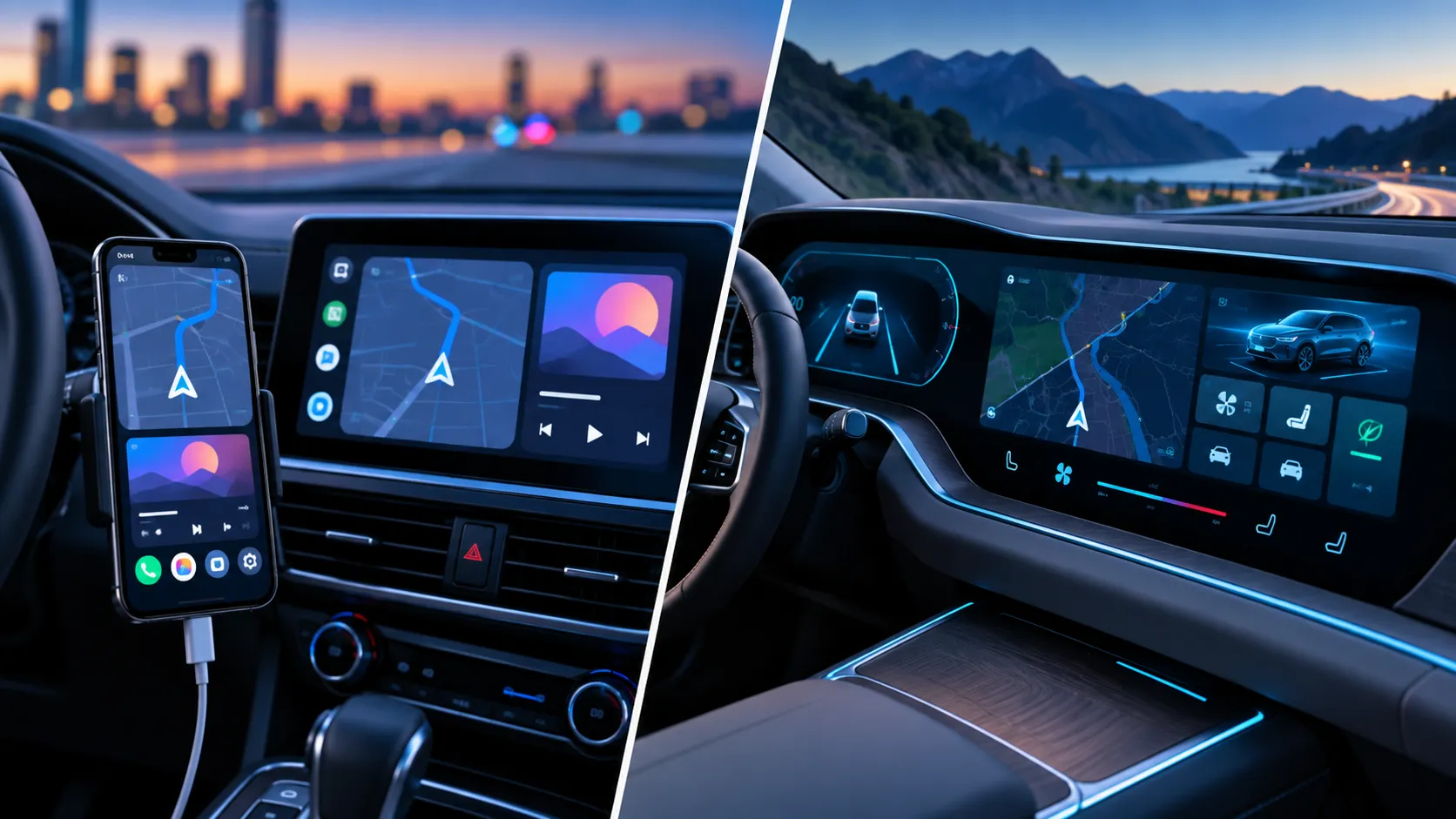
Two rows on a spec sheet, two names with "Android" in them, and a lot of shoppers who assume they're the same feature wearing different labels. They're not.
Android Auto vs Android Automotive OS comes down to where the software actually lives: Android Auto is a phone-based interface a car borrows for a few hours, while Android Automotive OS (AAOS) is an operating system automakers deploy directly onto the vehicle, not a phone feature the car projects onto its own screen.
Mix the two up on a build sheet, and it's possible to pay for a "smart" infotainment system that's really just a screen your phone is talking to, or overlook a car that's actually running Google's automotive platform under the hood.
A reply posted in Google's Android Auto support community last November draws roughly that same line, calling Android Auto and a vehicle's own software "two completely different things" that "are not related in any way." The same thread establishes something buyers can check for themselves: whether a car supports Android Auto at all, and whether that support arrives wired, wireless, or not at all, is a decision each automaker makes on its own.
AAOS gets treated differently by Google, evidenced by a dedicated AAOS security bulletin tracking vulnerabilities in the platform itself, apart from the Android Security Bulletin built for phones.
Here's a breakdown of what each one actually does, whether either can run without a phone, who's responsible for keeping the software patched, and what to check on a spec sheet before assuming a car has either one.
How does Android Auto work?
Google's support community describes Android Auto as "an app that your car manufacturer allows to run" on the vehicle's existing system, something a car either supports or doesn't rather than software built into the car itself. Google describes Android Auto as a phone-powered experience that displays a driver-optimized interface on a compatible car or aftermarket stereo when the phone is connected.
The same reply adds two details worth keeping in mind. It describes Android Auto as having "no deep access to your car's onboard system," and notes that plenty of automakers still don't support Android Auto or Apple's CarPlay at all.
What they establish clearly enough for a buyer's purposes: support isn't universal, so it needs verifying on a specific vehicle rather than assumed, and the support reply frames Android Auto's reach into the car's own systems as limited rather than full integration.
What is Android Automotive OS?
Automakers describe this platform with their own marketing terms, and a badge on a spec sheet doesn't always spell out which components are actually present. Research tracking the platform describes AAOS as "a well-known, customizable and secure operating system for OEMs," one that has "been gaining popularity in recent years, with several OEMs across the world already deploying it or planning to." That's a different relationship than Android Auto has with a car: it isn't a feature an automaker flips on for a compatible phone. It's an operating system automakers are adopting at the platform level.
One consequence of that setup: AAOS supports its own app ecosystem. Third-party developers can build apps that run on vehicles from multiple automakers at once, rather than mirroring whatever's installed on a driver's phone. Google backs that platform status up by publishing AAOS-specific security bulletins separate from the Android Security Bulletin phones use.
Android Automotive OS vs Android Auto: the key differences
Strip away the marketing and the differences come down to where the software runs and how far each one can reach into the vehicle.
Does it work without a paired phone?
Android Auto: Functions as an app projected from a connected phone; the supplied Google reply doesn't describe a phone-free mode.
Android Automotive OS: Built as the vehicle's own operating system with apps designed to run across multiple automakers.
Who decides if a car has it?
Android Auto: The automaker, model by model, including whether support is wired or wireless.
Android Automotive OS: Adoption happens at the automaker level, with several manufacturers already using or planning to use AAOS.
How much can it reach inside the car?
Android Auto: Google's support reply describes it as having "no deep access" to onboard systems.
Android Automotive OS: Certain navigation and point-of-interest apps can access some vehicle sensor data directly; this doesn't necessarily apply to every app.
Can a car run both at once?
Android Auto: Yes. Google says a car can run Android Automotive OS and also support Android Auto. AAOS cell: Yes. Android Automotive OS and Android Auto are not exclusive.
Android Automotive OS: Unconfirmed by the supplied research; check the specific model's spec sheet.
That last row deserves more attention than it usually gets. Some vehicles can run AAOS underneath while also offering Android Auto projection for drivers who prefer to use apps from their phone. Google explicitly says Android Automotive OS and Android Auto are not exclusive, though support still needs to be confirmed for a specific model.
Who controls software updates?
Google treats AAOS as its own patch target, publishing a dedicated bulletin apart from the Android Security Bulletin phones use. According to that bulletin, a full AAOS update combines that cycle's Android Security Bulletin patch level with whatever AAOS-specific fixes appear in the AAOS bulletin itself. The November 2024 bulletin, though, listed no AAOS-specific security patches that cycle, a reminder that this structure doesn't necessarily mean double the work every month.
What the bulletin doesn't say matters more to a buyer than what it does. It doesn't specify whether Google, the automaker, or a chipset supplier actually pushes an update to a given dashboard, how quickly, or for how many model years.
What deeper integration means for your data
Platform-level access gives AAOS reach that Android Auto's phone-projected setup doesn't have, and the 2023 study is specific about where that shows up. Navigation and point-of-interest apps built for AAOS can collect certain sensor data directly from the vehicle.
The study says the latest AAOS version it examined also let automakers configure and collect what Google's own documentation calls OEM telemetry, covering in-vehicle infotainment and vehicle data. The researchers surveyed 55 AAOS apps categorized as media, navigation, or point-of-interest software, then analyzed 14 apps of interest in more detail. More than 78% of those analyzed apps did not mention all of their dangerous permissions in their privacy policies.
Vehicle sensor data can carry personally identifiable information, and the study frames tighter in-vehicle network integration as coming at a cost to user privacy. The study says that privacy regulations in various regions require this kind of data collection to be clearly communicated to drivers, who are supposed to retain the right to approve or deny it, though the paper doesn't say how consistently that right shows up as an actual setting inside the car.
Though the study is from 2023, it's still a reasonable basis for a few concrete questions before trusting a built-in app with location or driving data: what the automaker's own privacy notice discloses beyond what Google publishes, whether telemetry collection can actually be limited from a settings menu, and whether an app's real permission requests match what its privacy policy claims.
What to check before you buy or rely on either one
Don't ask a dealer whether a car "has Android" and stop there. Look for the exact manufacturer wording in the equipment list or build sheet, then confirm whether it refers to Android Auto projection, built-in Google services, or the underlying infotainment platform, since badges and marketing terms don't always spell that out.
A few questions are worth putting to the dealer or the automaker's own documentation directly, since none of them are answered the same way across every vehicle:
Is a phone required for basic navigation, calling, or music, or does the car handle those functions on its own?
Is Android Auto wired only, wireless, or not offered at all on this specific trim?
Does this vehicle support Android Auto and AAOS together, or just one of them?
Who delivers software updates, over the air or otherwise, and does the automaker publish how long it will keep supporting them?
What does the automaker's own privacy notice say about data collection, separate from whatever Google's platform-level documentation covers?
The word "Android" on a spec sheet doesn't tell a buyer which of these two systems they're getting, whether it needs a phone, or who's responsible for keeping it secure. Get those answers in writing before assuming a car's infotainment system does more, or less, than its badge suggests.








Comments
Be the first, drop a comment!