



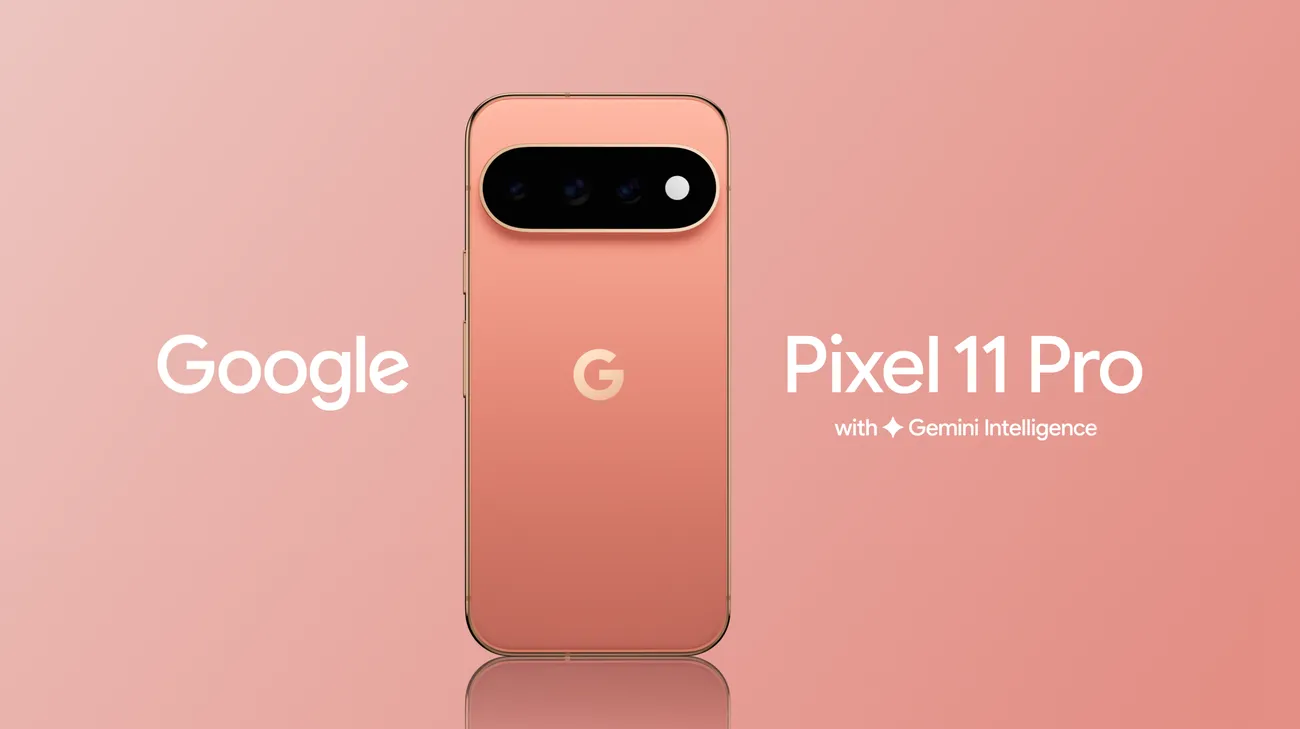
The Google Pixel 11 price increase lands the phone at $899 to start, essentially the same as Samsung's $899.99 Galaxy S26 and $100 above the iPhone 17's $799 starting price, according to Android Authority. For a phone line that built its reputation on undercutting Apple and Samsung, that's not a minor pricing update. It's the end of an era.
Google's own explanation came from devices VP Shakil Barkat, who told 9to5Google, as reported by The Verge in July, that "the economics have fundamentally shifted" and that future pricing would roll out "dynamically to match supply realities." That's a hedge, not a promise. Google isn't saying prices will only climb from here, just that they'll move with supply conditions, whatever that ends up meaning for the next phone.
Google introduced four new Pixel models on August 12: the Pixel 11, Pixel 11 Pro, Pixel 11 Pro XL, and a Pixel 11 Pro Fold that sits outside the scope of this comparison (The Verge). All four carry starting prices $100 higher than their Pixel 10-series counterparts in the US, though the base Pixel 11 and Pixel 11 Pro also double their minimum storage from 128GB to 256GB.
None of this makes the Pixel 11 a bad phone. But Google has removed the one thing that made recommending a Pixel simple: its price cushion. What's left is a case that depends entirely on who's asking, a first-time buyer or someone already holding a Pixel 9 or 10.
Google Pixel 11 price increase: how Pixel pricing caught up
The Pixel 6 arrived in 2021 at $599, with the Pro at $899, undercutting the iPhone 13 and Galaxy S22 at $799 and blowing past their top-tier siblings, the iPhone 13 Pro Max and Galaxy S22 Ultra, at $1,099 and $1,199 (Android Authority). That gap was the entire pitch: flagship features for hundreds less than the competition.
By the time the Pixel 10 launched, prices had already caught up to what Apple and Samsung had been charging for years. It only looked like a bargain again briefly when Samsung raised Galaxy S26 pricing earlier this year (Android Authority).
The Pixel 11 closes the loop. Its $899 starting price matches the Galaxy S26's launch MSRP almost exactly and sits $100 above the iPhone 17. All three start with 256GB of storage, so the comparison no longer needs a storage caveat.
That doesn't mean Google's $100 higher starting price buys nothing. The Pixel 11 replaces the Pixel 10's 128GB base configuration with 256GB, and the Pixel 11 Pro makes the same jump. In fact, the 256GB Pixel 11 and Pixel 11 Pro cost the same at launch as the equivalent 256GB Pixel 10 and Pixel 10 Pro did.
The real price increase is therefore clearest at the entry point, where buyers can no longer choose a cheaper 128GB model, and on the Pixel 11 Pro XL, which rises $100 while remaining at 256GB.
Still, this is a five-year trendline, not a single rough year. The identity Google built with the Pixel 6, flagship specs at a discount, no longer defines the lineup.
What buyers actually get: the case splits sharply by tier
The base Pixel 11 makes the strongest case in the lineup. The higher starting price comes with something concrete attached: storage doubles from 128GB to 256GB, and RAM lands at 12GB (The Verge).
It also picks up the new Tensor G6 chip. Google says its upgraded CPU delivers 25% faster web browsing and 15% quicker app launches, company claims rather than independent benchmark results. Software additions include Magic Capture, Camera Looks, expanded Live Translate, and a camera-based version of Circle to Search (The Verge).
The Pro models are more complicated. The Pixel 11 Pro starts at $1,099, $100 above the Pixel 10 Pro's $999 entry price, but it now starts at 256GB instead of 128GB. The previous 256GB Pixel 10 Pro also cost $1,099, so the like-for-like storage price hasn't actually changed.
There's a trade-off, though: the base 256GB Pixel 11 Pro has 12GB of RAM, down from the 16GB included across every Pixel 10 Pro configuration.
The Pro XL is the tougher sell. It starts at $1,299, $100 more than the Pixel 10 Pro XL, while keeping the same 256GB base storage and dropping from 16GB to 12GB of RAM at that tier.
On cameras, the reporting isn't actually contradictory once the details are separated. Google describes the Pro's 50MP main camera as using a brand-new sensor, while its 1/1.3-inch size and 50MP resolution remain the same as the Pixel 10 Pro. The telephoto unit is more clearly changed, with Google saying its larger sensor delivers 30% more light sensitivity.
Real gains do exist, and they're worth separating from Google's marketing claims. The standard Pixel 11 Pro gets faster Qi2.2 wireless charging, both Pro models have brighter Super Actua displays, and Google added Extreme Charging Mode across the Pixel 11 line. Night Sight can also capture up to 4.5 times faster, according to Google.
Set against those gains are two clear hardware reductions. The Pixel 11 Pro's battery capacity falls slightly from 4,870mAh to 4,850mAh, while the Pro XL drops by 85mAh, from 5,200mAh to 5,115mAh. Capacity alone doesn't establish worse real-world battery life, especially with a new processor, but neither model gets the bigger cell an upgrade buyer might expect.
EPREL registry data also shows the Pro line's drop-resistance grade slipping from an A to a B, according to Android Police. One Android Police reviewer who'd been planning to upgrade from a Pixel 9 Pro XL called the Pixel 11 Pro "far from the giant leap forward" they'd expected.
That split matters. The Pixel 11 and Pixel 11 Pro pair their higher entry prices with doubled base storage. The Pro XL does not, and that's where the missing price cushion starts to bite hardest.
Is the Pixel 11 worth the price?
The answer changes depending on which phone is currently in a buyer's pocket.
For someone shopping for a first phone among the Pixel 11, Galaxy S26, and iPhone 17, the base Pixel 11 holds up reasonably well. The $899 price buys 256GB of storage and 12GB of RAM out of the box, plus Google's software suite.
The decision at this price point comes down more to hardware and software priorities than storage, since the Pixel 11, Galaxy S26, and iPhone 17 all now start at 256GB, with the Pixel and Galaxy separated by essentially nothing at MSRP and the iPhone sitting $100 lower.
Pixel 9 or 10 owners considering the base Pixel 11 are looking at incremental gains: Tensor G6's claimed 25% faster web browsing and 15% quicker app launches, longer zoom range, and the expanded Live Translate and Circle to Search features (The Verge). None of that is essential, but none of it is nothing either.
Pixel 9 or 10 Pro owners face tougher math. The Pixel 11 Pro's entry price rises, but its base storage doubles, and the 256GB model costs the same as last year's 256GB Pixel 10 Pro did. The downside is that the entry configuration now carries 12GB of RAM instead of 16GB.
The Pro XL is less forgiving. It costs $100 more at the same 256GB capacity, starts with less RAM than its predecessor, and combines camera and charging refinements with a slightly smaller battery and lower EPREL drop-resistance grade.
For anyone buying a Pro-tier Pixel for the first time, that distinction matters. The Pixel 11 Pro's higher starting price is tied to eliminating the 128GB tier. The Pixel 11 Pro XL's is a genuine $100 increase at the same starting storage.
The camera and Night Sight improvements are real on paper, but several headline numbers, including Google's browsing, app-launch, and 4.5x Night Sight claims, still come from Google rather than broad independent testing.
The supply-cost defense, worth noting, not worth overweighting
Barkat's rationale is that Google "shielded consumers from supply fluctuations for as long as possible" before economics forced its hand (The Verge). Android Authority connects the dots further, tying rising component costs to RAM shortages driven by the generative-AI boom, and argues that Google, as one of the largest players in that same AI industry, bears some responsibility for a cost spike it helped create (Android Authority).
That's a fair accountability argument. It is not, however, a documented one. There's no supplier data, margin breakdown, or component-cost analysis behind the claim, just an editorial inference from a writer at the outlet.
Treat it as a reasonable caveat on Google's framing rather than proof that Google chose margin over customers.
Who should actually buy one
The trajectory is clear even if the motives behind it aren't fully documented: Google Pixel phones have gone from a value proposition built on undercutting rivals to pricing that now sits directly alongside them, while some configurations make compromises that weren't present last year.
The base Pixel 11 remains defensible for a new buyer who wants Google's software, 256GB of storage, and the updated camera system. The Pixel 11 Pro also softens its higher starting price by doubling base storage, though its 12GB base RAM configuration is a step backward from the Pixel 10 Pro.
The Pro XL is tougher to justify for anyone already holding a Pixel 9 or 10 Pro XL. Its $100 increase doesn't bring a storage bump, its entry-level RAM drops from 16GB to 12GB, and its battery capacity and EPREL drop-resistance grade both move in the wrong direction, even as cameras, charging, and display brightness improve.
Barkat's comments leave the door open to further pricing changes as supply conditions shift. That's not a guarantee of more increases, just an acknowledgment that Pixel pricing may now move more directly with component economics.
What happens next depends less on this year's sticker price than on whether Google can win buyers on hardware and software alone, without the discount that once made the Pixel decision much easier.









Comments
Be the first, drop a comment!