



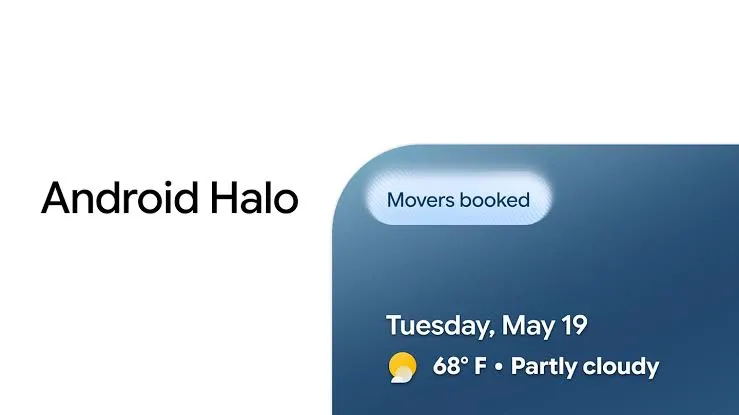
At first glance, Android Halo looks like a sensible piece of UX design. Google's description is straightforward: a persistent indicator at the top of your phone screen where an AI agent can update you, ask for input, and surface results from background tasks, all without interrupting whatever you're doing. Google's official announcement previewed this in May as "at-a-glance visibility into what your agent is working on at any given time." That is a real problem, and this is a reasonable solution to it.
Here is the plain version of what Android Halo actually is: a fixed location in your phone's status bar that acts as a communication channel between you and any AI agent running tasks in the background. Imagine booking a flight through an AI assistant while you keep using other apps. Halo is the persistent dot at the top of the screen that tells you the agent is still working, lets you check its progress, and surfaces results when it finishes. It does not scatter across different apps or disappear when you switch screens. It stays put.
The structural weight underneath that clean UX solution is what deserves scrutiny.
Google VP Sameer Samat described Android Halo as "a dedicated location in the status bar" where "your agent of choice, Gemini or another agent" can communicate during long-running tasks. That framing is notable. So is this line from Google's own security blog, published in May: "Android is evolving from an operating system into an intelligence system." That is not product-launch boilerplate. It is a description of a new platform architecture, which means Halo is not just a feature. It is a foundational layer being baked into the OS.
One day after Google clarified what Halo actually does, Europe's top court upheld a €4.1 billion antitrust fine against Google for using Android to entrench Search and Chrome through restrictions on device makers and carriers. That ruling did not cause Halo. But it provides context that is impossible to ignore: Google is building a new system-level interface for AI agents on the same platform whose old defaults a court just confirmed were anticompetitive.
The argument here is specific. Halo creates a new default layer for AI agent interaction inside Android. The open and currently unanswered question is whether rival agents get genuinely equal access to that layer, or whether "supported agents" turns out to mean something narrower in practice than it sounds in a product announcement.
What is Android Halo, exactly?
Think of Halo as a standardized command-and-status channel between the user and background AI tasks, anchored to a fixed spot so it does not scatter across different apps. As Google's blog described it in May, the feature "brings subtle communication to the top of your phone screen as it takes on a task, goes into live mode or sends you a message," visible regardless of which app is open. 9to5Google draws a fair analogy to Live Notifications: a persistent, consistent location that does not shift depending on context.
Google's transparency commitments here go further than a typical feature launch. When Gemini automates a task, users can watch it work in real time via "View progress." If they navigate away, a notification chip stays pinned at the top of the screen and cannot be dismissed, so it is always clear the agent is still running. The Google Security Blog also confirmed in May that Android's Privacy Dashboard will be updated to log which AI assistants were active and which apps they accessed in the previous 24 hours. Key parts of the AI security architecture are described as open-source, binary transparent, and reviewed by third-party auditors.
What Google has not said is where the real question lives. Halo will arrive "later this year" and will work with "Gemini Spark and other supported agents," with no announcement of which third-party agents qualify. On "most advanced devices," Halo gains "additional capabilities" through Gemini Intelligence, with details deferred to a later date. No full user interaction with Halo has been publicly demonstrated. No API specifications for third-party agent access have been published.
Those are not minor omissions. They are precisely where the Android Halo concerns live.
The specific risk: one new chokepoint, built into the OS
The deepest mechanism to watch is tiered capability by device. Halo's "additional capabilities" are explicitly tied to Gemini Intelligence on Google's "most advanced devices," according to Google. That setup raises the possibility that Halo delivers a richer experience for Gemini on premium hardware while other agents get nominal access, and that asymmetry does not require explicit exclusion. It just requires that the experience be meaningfully better for one party than others by design, in the same way pre-installed defaults worked in the old Android bundling case.
To make that concern concrete: genuine equal access to Halo would require specific, verifiable things. Third-party agents would need the same API access to Halo's status-bar location; the same ability to surface background tasks across the full device lineup, not just devices without Gemini Intelligence; comparable wake-word activation rights; and the same permission to perform integrated actions — sending emails through preferred apps, ordering food, sharing photos — that Google's own assistant can perform.
The European Commission's draft DMA measures for Android are essentially a regulatory version of that checklist. Earlier this year, the Commission proposed requiring Google to open key Android functionalities to competing AI providers, including integrated task execution, wake-word parity, and access to device capabilities that the Commission says are currently reserved largely for Google's own AI services, Antitrust Intelligence reported. Regulators are writing that list because they do not trust stated openness to produce those outcomes without explicit interoperability requirements.
EU Executive Vice-President Teresa Ribera framed the DMA remedies as necessary to protect innovation by AI companies of all sizes and expand user choice in the mobile AI market, per Antitrust Intelligence. Halo is launching directly into that market. If it becomes the primary interface layer for AI assistants acting on your behalf on Android, which is exactly what Google's "intelligence system" framing implies, then who gets into Halo on what terms is not a developer-relations question. It is a market structure question.
Google's best defense and what it leaves open
Google's most credible defense is that Halo was described from day one as working with "your agent of choice, Gemini or another agent." After the EU court ruling, Google stated that the judgment "fails to recognize our significant investment to ensure Android remains open, interoperable and free," and affirmed its commitment to "continued innovation and openness for our users, partners and developers." That is not nothing. Google has an institutional interest in maintaining Android's appeal to OEMs and developers, and a platform visibly rigged against third-party agents would damage that relationship.
The transparency architecture also deserves honest credit. Per-app automation controls, opt-in requirements for features like Gemini Autofill, and activity logs in the Privacy Dashboard represent a more deliberate attempt to make agent behavior legible to users than most AI systems have attempted. Dismissing all of that as marketing would be unfair.
What Google's defense does not resolve is the core problem the DMA remedies were designed to address. The Commission is not alleging that Google has already blocked rivals from Halo. It is acting to prevent the conditions for that outcome from hardening before they do.
FairSearch's observation after the ruling that the legal process moved too slowly to prevent Google from entrenching mobile dominance before any remedy took hold is a fair description of how platform defaults actually work. By the time there is evidence of harm, the defaults are already entrenched.
The honest position: Google may be acting in good faith. Platform openness that depends on Google's continued willingness to remain open is still not a structural guarantee. It is a policy preference, and policies shift when competitive pressure does. Openness by statement is not the same as openness by design.
What to watch, and why the timing matters
The announcements that would confirm or ease the concern are specific. Which third-party agents will be supported at Halo's launch, and under what API terms? Will those agents get Halo access across the full Android device lineup, or only on devices without Gemini Intelligence? What can a rival assistant do through Halo that Gemini can do, and what can it not? Google has said it will share more details later this year. When it does, those details will reveal whether Halo's openness is architectural or rhetorical.
The regulatory clock is already running. The EU's DMA proceedings on Android AI interoperability must reach a final decision within six months of the proceedings opening, per Antitrust Intelligence. The court ruling also signals a shift in regulatory posture: the focus moves from punishing past conduct to enforcing ongoing behavioral obligations under the DMA. What Google builds into Halo before that decision lands will likely be the baseline regulators are working to open up. Baselines are much easier to establish than they are to dismantle.
Ordinary Android users, if Halo becomes the primary way they interact with AI agents acting on their behalf, will be doing so through an interface Google designed and controls. Rival assistant developers need equal API access, feature parity, and full device reach, not nominal inclusion on a "supported agents" list whose membership criteria have not been published. The concern about Android Halo is not that Google has already done something wrong. It is that the architecture being assembled right now will be significantly harder to open up later than it is to get right from the start.


Comments
Be the first, drop a comment!